

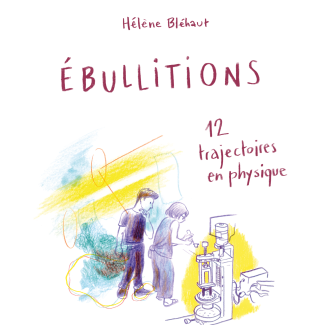
Valentina Emiliani dans Ébullitions
Découvrez le portrait de Valentina Emiliani dans la bande-dessinée "Ébullitions, 12 trajectoires en physique"
https://www.inp.cnrs.fr/fr/ebullitions

Valentina Emiliani is a CNRS senior researcher at the Institut de la Vision in Paris. After obtaining a PhD in physics from La Sapienza University in Rome, she worked as a postdoctoral researcher at the Max Born Institute (Berlin) and then at the European Laboratory for Nonlinear Spectroscopy (Florence). In 2002, she joined the Jacques Monod Institute (Paris). Recruited by the CNRS as a CRCN (2004), she founded (2005) the ‘Wave Front Engineering Microscopy’ group at Paris Descartes University. In 2014, she headed the Neurophotonics Laboratory at the same university. In 2018, she joined the Institut de la Vision with her group. She was awarded the CNRS Silver Medal in 2021.
She is a pioneer in the application of wavefront modulation techniques in neuroscience. In particular, she has developed several methods—such as computer-generated holography, generalised phase contrast and temporal focusing combined with multiphoton excitation—to sculpt the illumination volume into a shape perfectly suited to the chosen target. Combined with optogenetics or voltage imaging, wavefront modulation allows for control of neural activity with unparalleled spatiotemporal precision. His work has paved the way for fully optical manipulation of brain circuits with cellular-level resolution, an essential methodology for disrupting or activating neural circuits in order to explore how the brain works.
The optogenetics revolution began with the discovery of light-sensitive proteins (opsins) that can be activated by light. Their use makes it possible to control the activity of specific neuronal populations, enabling functional mapping of the brain for the first time. However, the field illumination traditionally used in optogenetics activates large populations of neurons synchronously and does not achieve the precision needed to reproduce the complex, natural firing patterns of neural circuits. To overcome this limitation, Emiliani's laboratory has developed ‘circuit optogenetics,’ combining computer-generated holography, temporal focusing, and two-photon excitation. This technique enables optogenetic control of neural circuits with millisecond temporal precision and spatial precision that allows single cells deep within brain tissue to be targeted. These methods have enabled the mapping and manipulation of neural circuits in mice with unprecedented precision.
The HOLOVIS project has made several important advances. Thanks to ultra-fast sequential holographic targeting, it is possible to increase the number of targets that can be reached. Tri-photon holography makes it possible to reach deep layers of the brain. Finally, bi-photon holographic endoscopy enables optogenetic control of neural circuits in freely moving mice. The current goal is to apply this same precision to non-human primates. The project aims to develop 2P-MINOPS, an integrated and miniaturised bi-photon system based on recent advances in miniaturised sources, modulators and detectors. This platform will enable wireless optical study and manipulation of brain circuits in freely moving primates, paving the way for new research into complex brain functions in models closer to humans.