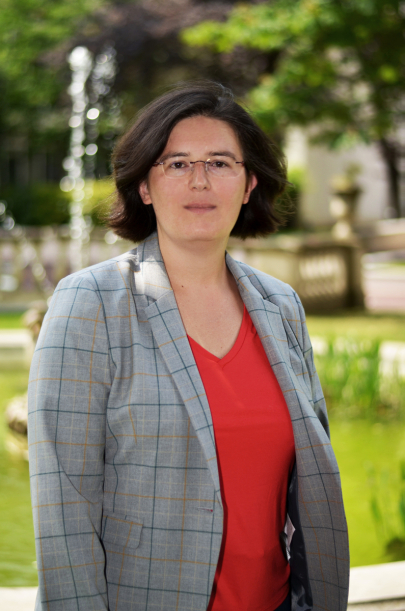

Sophie CarencoChercheuse CNRS au Centre interdisciplinaire de nanoscience de Marseille (CINaM)
Proof of concept
Starting Grant
Sophie Carenco is a chemist specialising in nanochemistry, materials chemistry and catalysis, with a particular interest in the surface reactivity of nanoparticles. Her research focuses on the design of original nanomaterials and the study of their chemical properties.
A former student of the École Polytechnique, she obtained a PhD in chemistry from Sorbonne University in 2011. She then completed a two-year postdoctoral fellowship at Lawrence Berkeley National Laboratory in the United States. In 2014, she was recruited as a research fellow at the CNRS, at the Laboratoire de Chimie de la Matière Condensée de Paris (CNRS, Sorbonne University). There, she developed an original approach combining synthesis, advanced characterisation and surface chemistry. In 2017, she was awarded an ERC Starting Grant for her NanoFLP project. She became a research director in 2022 and joined the Interdisciplinary Centre for Nanoscience in Marseille (CINaM, Aix-Marseille University/CNRS) in 2025. Her work has been recognised with several awards, including the CNRS Bronze Medal in 2018 and the Fédération Gay-Lussac/Académie des Sciences Prize in 2025.
ERC PoC 2025 : Precise Deuteration at the Tailored Surface of Nickel Phosphide Nanocatalysts (PRELUDE)
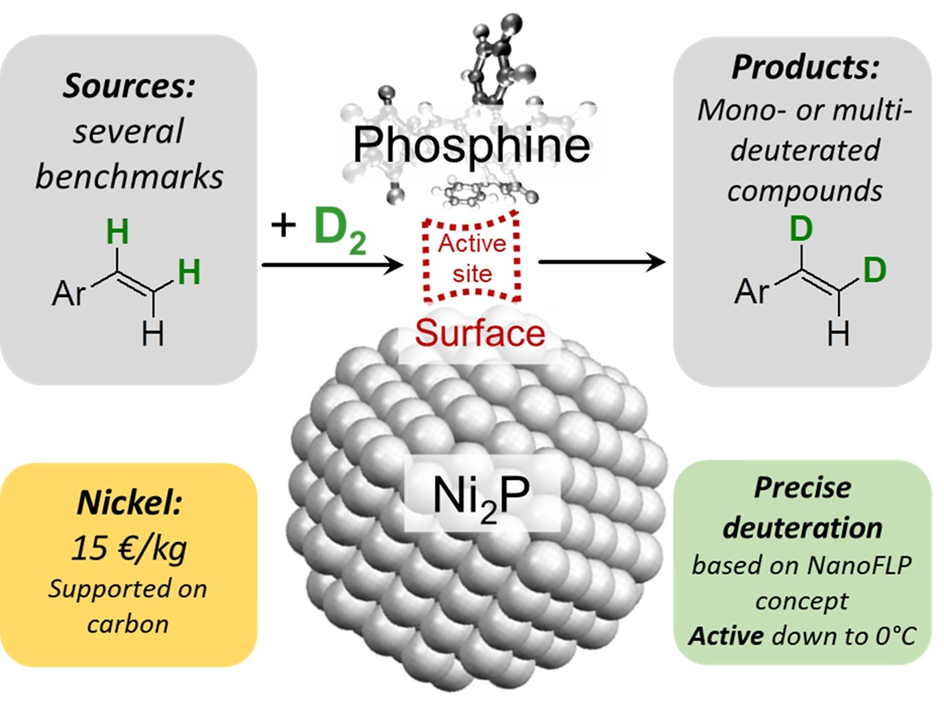
The PRELUDE project aims to develop a new catalyst for producing deuterated organic molecules, which are essential in medicines, metabolic tracers and OLED screens. Today, these molecules are expensive and difficult to synthesise, as their production relies on rare metals such as ruthenium and iridium, and highly selective processes.
What is innovative about PRELUDE? Using nickel phosphide (Ni₂P) nanoparticles, a material 100 times cheaper than current catalysts, combined with phosphines to guide the reaction with precision. This catalyst will enable deuterium (a hydrogen isotope) to be introduced at low temperatures (0°C) in a targeted and efficient manner into selected molecules.
The challenge is twofold: to reduce costs and improve selectivity in order to meet the needs of the pharmaceutical, medical diagnostics and high-tech materials industries. The market for deuterated compounds, estimated at €1 billion by 2033, could thus become more accessible and sustainable.
PRELUDE builds on the advances made in the ERC NanoFLP project, where Sophie Carenco demonstrated the effectiveness of these nanocatalysts for hydrogenation. With this new project, she is embarking on a key step: moving from the laboratory to a more mature technology.