

Understanding the transformation of a material using ultrashort laser pulses: from quantum physics to thermodynamics
Using an X-ray laser, researchers have discovered how ultra-brief quantum phenomena induced at the atomic scale by light translate into electronic pressure – a pressure capable of transforming a crystalline material and altering its macroscopic properties.
References
Multiscale phase nucleation driven by photoinduced polarons in a volume-changing material, Marius Hervé, Gaël Privault, Serhane Zerdane, Shintaro Akagi, Leland B. Gee, Ryan D. Ribson, Matthieu Chollet, Shin-ichi Ohkoshi, Hiroko Tokoro, Marco Cammarata, Eric Collet, Nature Materials - Published: 19 March 2026.
DOI : 10.1038/s41563-026-02521-w
Open access : https://www.researchsquare.com/article/rs-6871744/v1
In recent years, physicists have been using light to control the physical properties of materials at ultra-high speeds. This makes it possible to alter a material’s colour, conductivity or magnetic properties on timescales well below a billionth of a second. The mechanisms driving these processes are poorly understood, as they involve various phenomena occurring within a crystal on vastly different timescales and spatial scales, ranging from the quantum dynamics of atoms and electrons to the thermodynamic equilibrium of the system as a whole. Understanding these phenomena is an essential step towards designing new devices based on the control of these properties using light, but the multi-scale nature of these phenomena significantly hinders our ability to optimise them.
The present study was carried out in the following CNRS laboratories:
- Institut de Physique de Rennes (IPR, CNRS / Université de Rennes)
- Dynamical Control of Materials (DYNACOM, CNRS / Université de Rennes / Université de Tokyo)
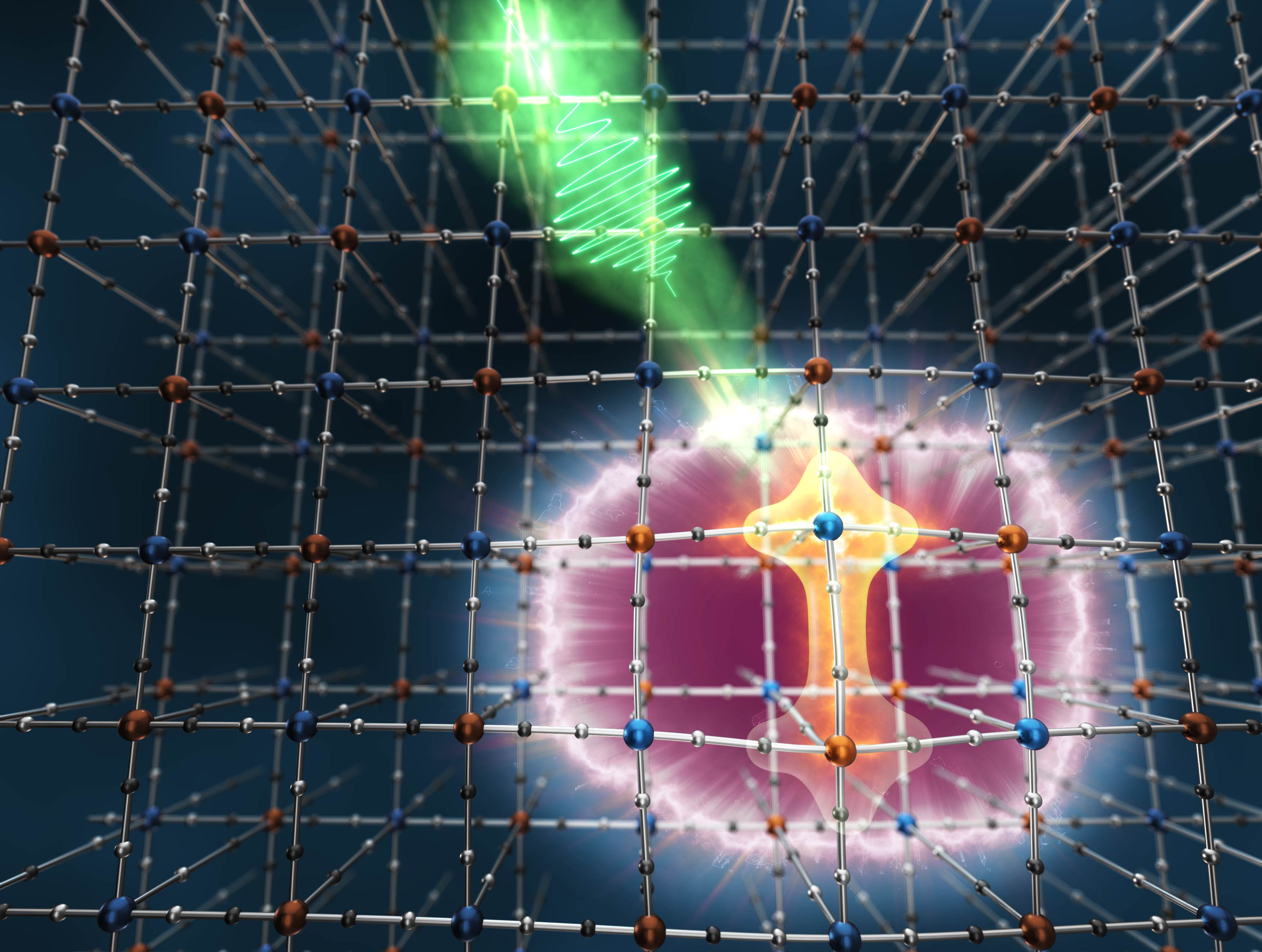
In a recent study, a Franco-Japanese team of researchers used a laser generating ultrashort X-ray pulses at Stanford to study Prussian Blue Analogues (PBA). These materials are known for their photomagnetic and phototherapeutic properties. It has been demonstrated in a PBA crystal based on manganese and iron ions that a flash of light can make this material magnetic or even permanently change its colour at room temperature. However, the lack of adequate measurements at sufficiently high spatial and temporal resolutions has, until now, prevented an understanding of the underlying non-equilibrium dynamics of this process. The use of an ultra-short X-ray pulse laser enabled the researchers to detail and understand the cascade of mechanisms responsible for the transformation of these crystals by light. They have thus demonstrated that the light pulse excites electrons and alters the atomic arrangement in 50 billionths of a second, or 50 femtoseconds (1 fs = 10⁻¹⁵ s). The electron, subsequently transferred from the iron atom to the manganese atom, and unable to occupy the same quantum state as the other electrons (due to the Pauli exclusion principle), then occupies a less bound state, which distorts the crystal structure and induces internal pressure. The study demonstrates that this is the key step in the process, as this distortion then propagates throughout the entire crystal and induces a cascade of electron transfer. The material then reaches a new state of equilibrium, where its new atomic and electronic reorganisation determines new properties.
The flexibility of the crystal lattice appears to be an essential parameter for the efficiency of the process, as it allows the light-induced electronic changes to be effectively trapped. The researchers therefore predict that optimising this will lead to the development of efficient photoactive devices. These results are published in the journal Nature Materials.