
Shaping the fate of cells using a dynamic map of development
Is it possible to predict and steer the fate of developing cells without knowing all the details of the molecular mechanisms that govern them? By combining mathematical modelling with experiments in the nematode C. elegans, researchers have shown that it is possible to quantitatively guide choices regarding cellular fate by influencing the timing of biological signals.
References:
Quantitative guiding of developmental cell fate patterns using a dynamical landscape model. Ismail Hajji, Francis Corson, Wolfgang Keil, Proceedings of the National Academy of Sciences (PNAS) U.S.A. 123 (30) e2521973123 - Published July 20, 2026.
DOI: 10.1073/pnas.2521973123
Open access: bioRxiv
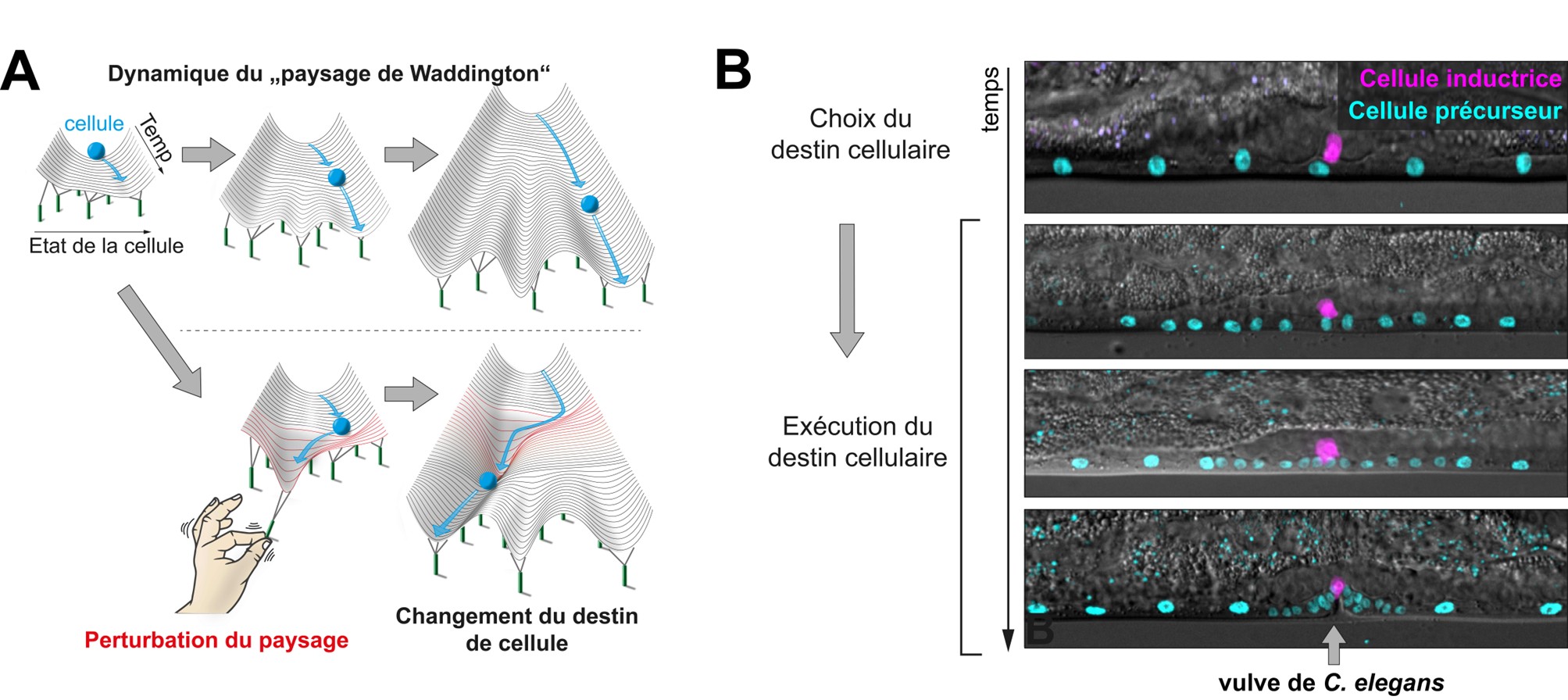
During the development of an organism, cells gradually transition from an undifferentiated state to specialised identities. Understanding how these choices are made – and, above all, how to predict or steer them – is a major challenge for developmental biology and regenerative medicine. For several years, biologists have drawn on the metaphor of the ‘Waddington landscape’, in which a cell follows different valleys leading to distinct fates (Figure 1A). Mathematical models inspired by this idea have already helped to explain the final states observed in several biological systems.
This research was carried out in the following CNRS laboratories:
laboratoire Physique des Cellules et Cancer (PCC, CNRS / Institut Curie / Sorbonne Université)
Laboratoire de Physique de l’Ecole Normale Supérieure de Paris (LPENS, CNRS / ENS-PSL / Sorbonne Université / Université Paris Cité)
In a recent study, researchers have demonstrated that it is now also possible to predict the dynamic trajectories followed by cells during actual development. Using a Waddington landscape model, they were able not only to reproduce the complex cellular behaviours observed in the nematode Caenorhabditis elegans, but also to anticipate the effect of temporal perturbations and suggest how to steer cells towards a chosen fate.
To achieve this, the researchers studied vulva formation in C. elegans, a model system in which six identical precursor cells (Figure 1B, turquoise) can adopt different fates under the influence of a signal emitted by an inducer cell (Figure 1B, magenta) and communication between the six cells. The researchers combined a mathematical model representing cellular states within a Waddington landscape with temperature-sensitive mutants, enabling these signals to be increased or decreased at specific points during development. The model accurately predicts the effects of complex genetic combinations, including certain counter-intuitive outcomes previously attributed to specific molecular interactions. Even more original is its prediction that early signalling pulses are much more effective than late ones, even when the total amount of signals received is the same. Experiments have confirmed these predictions, showing that the timing of signal application strongly determines the final fate of cells. These results demonstrate the predictive power of ‘landscape’ approaches and pave the way for strategies to rationally control cellular decisions, with implications for tissue engineering and regenerative medicine. They have been published in the Proceedings of the National Academy of Sciences.