Probing critical fluctuations associated with a phase transition
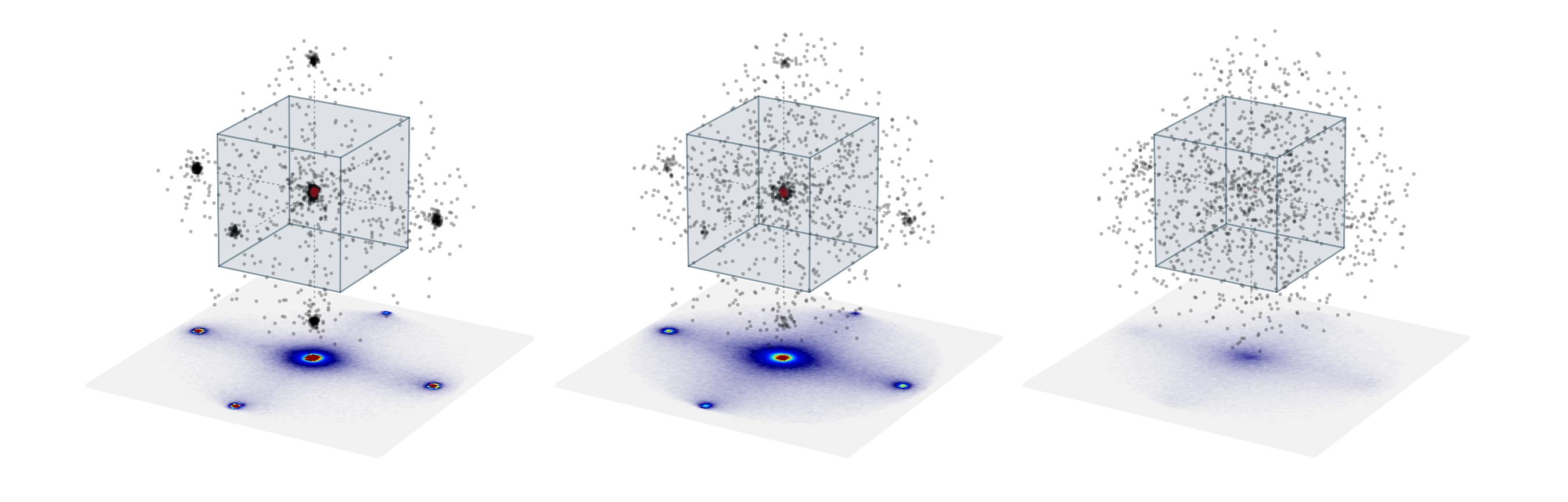
A phase transition is characterized by an order parameter whose fluctuations cease to obey Gaussian statistics within a narrow window around the transition. By reconstructing the full distribution of the order parameter atom by atom in an ultracold Bose gas, a French team reveals a universal behavior as well as a subtle and unexpected quantum signature, making these fluctuations a new probe of universality.
References:
Maxime Allemand, Géraud Dupuy, Paul Paquiez, Nicolas Dupuis, Adam Rançon, Tommaso Roscilde, Thomas Chalopin, David Clément. Non-Gaussian statistics of the order parameter across a phase transition. Nature 655, 1148–1153 (2026).
DOI: 10.1038/s41586-026-10811-1
Open archive: arXiv
Second-order phase transitions obey scaling laws and the concept of universality: microscopically very different systems that belong to the same universality class share the same critical exponents. These exponents are typically measured to characterize a transition. However, universality manifests beyond these exponents: it resides in the probability distribution of the order parameter across the transition, where non-Gaussian statistics are expected but remain largely unexplored.
In a recent study, a French team leveraged single-atom-resolved detection to investigate the finite-temperature superfluid transition, a phase transition between a superfluid and an insulating state. The scientists measured the full probability distribution of the order parameter amplitude across this transition in a gas of approximately 4,000 metastable helium atoms (⁴He*) loaded into an optical lattice. The strength of the approach lies in the single-atom-resolved detection in momentum space, specific to metastable helium, which enables the reconstruction of the entire probability distribution of the order parameter and thus all its cumulants.
This research was carried out in the following CNRS laboratories:
- Laboratoire Charles Fabry (LCF, CNRS / Institut d'Optique Graduate School)
- Laboratoire de physique théorique de la matière condensée (LPTMC, CNRS / Sorbonne Université)
- Physique des lasers, atomes et molécules (PhLAM, CNRS / Université de Lille)
- Laboratoire de physique de l'ENS de Lyon (LPENSL, CNRS / ENS de Lyon)
Three key findings emerge from this study. First, the order parameter statistics become distinctly non-Gaussian within a narrow window around the transition, confirming theoretical predictions. Second, the measured distributions are very well described by an effective "Landau-like" potential featuring a non-trivial minimum on the superfluid side (the ordered phase) that vanishes at the transition. Finally, higher-order cumulants exhibit abrupt sign changes near the transition.
A systematic comparison with numerical simulations shows that while classical phase transition models reproduce the sign changes of the cumulants, they fail to quantitatively describe their behavior near the transition. These discrepancies are attributed to universal scaling corrections originating from the contribution of quantum fluctuations at low temperatures. Higher-order cumulants thus act as a magnifying glass, revealing subtle quantum effects at the very heart of a finite-temperature transition.
The interest of this method goes beyond measuring critical exponents: it provides a direct complement, particularly well-suited to mesoscopic systems. Moreover, the sign changes of the cumulants are not unique to this universality class and are general features of criticality. This method is of interest to both quantum simulators and the study of transitions in contexts such as the phase diagram of quantum chromodynamics (the transition between hadron gas and quark-gluon plasma), where the signs of cumulants are considered promising probes.