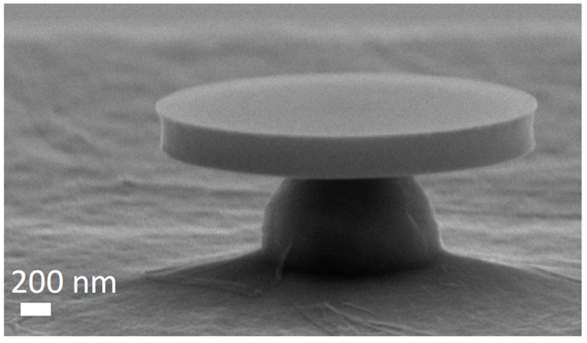
An optomechanical disc in its fundamental vibration mode
Using light as a probe, researchers have recently demonstrated that micrometre-scale optomechanical discs can, at very low temperatures, enter a quantum regime characterised by a complete absence of spontaneous vibrations – an important step towards manipulating their quantum vibrations for applications in sensor engineering and quantum information.
References:
Andrea Barbero, Samuel Pautrel, Bertrand Evrard, Jérémy Bon, Romain Dezert, Aristide Lemaître, Adrien Borne, Ivan Favero, Optomechanical Disk Resonator in the Quantum Ground State of Motion, Physical Review Letters (2026).
DOI: 10.1103/r7gg-w6kg
Open archive: HAL
At room temperature, the atoms that make up an object oscillate constantly and in a disordered manner as a result of thermal motion. To reveal the quantum properties of a mechanical device, this thermal motion must be virtually eliminated, which is achieved by cooling the device as much as possible. One way to measure the system’s residual temperature is therefore to couple its motion to light and measure the light.
This research was carried out in the following CNRS laboratories:
- Laboratoire Matériaux et Phénomènes Quantiques (MPQ, CNRS / Université Paris Cité)
- Centre de Nanosciences et de Nanotechnologies (C2N, CNRS / Université Paris-Saclay)
In a recent study, researchers have thus observed and quantified the cooling of an optomechanical disc, at a final stage where the disc is predominantly in its fundamental quantum vibrational state, the ‘phonon vacuum’. The discs used are micrometre-sized objects made of a semiconductor material (gallium arsenide), whose natural vibration frequency lies in the gigahertz range. Over the years, they have underpinned numerous advances as sensors: in magnetometry, in high-frequency fluid rheology, and in the mass measurement of individual nanoscale objects – but only in the classical regime, where any quantum effect is completely negligible.
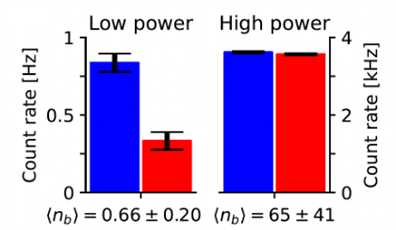
To enter the quantum regime, the researchers first cooled the device in a dilution refrigerator to a temperature of around 10 millikelvins. They then probed its vibrational state by alternately using two lasers: one with a frequency slightly below the disc’s optical resonance frequency and the other slightly above it, with the spectral shift corresponding to the disc’s vibrational frequency. This then makes it possible to quantify the processes of phonon creation and annihilation – the elementary vibrational excitations of the system. When the resonator reaches its ground state, the annihilation of a phonon becomes extremely unlikely, as there is virtually no vibration left to suppress. Comparing the rates at which these two processes occur thus provides a direct measure of the quantum occupation of the mechanical mode. The measurements revealed an average occupation of 0.66 ± 0.2 phonons in the resonator, corresponding to a probability of approximately 60 per cent that the resonator is in its ground state. With this result, the researchers have thus demonstrated that the ultra-low-temperature regime, in which it is possible to manipulate, count, add and subtract the quantum vibrations of optomechanical discs, is now within reach. This work has been published in the Physical Review Letters.