The 2025 Nobel Prize in Physics explained by researchers from the PEPR Quantum
Analysis of the 2025 Nobel Prize in Physics by five researchers from the PEPR Quantum programme working in laboratories affiliated with CNRS Physics.
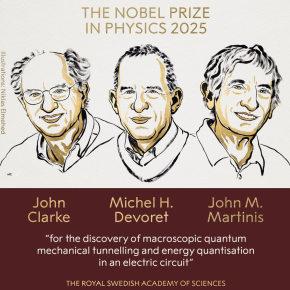
The Nobel Prize in Physics 2025 is awarded to John Clarke, Michel Devoret, and John Martinis for the discovery of macroscopic quantum tunneling and energy quantization in an electrical circuit.
Among the three laureates, Frenchman Michel Devoret completed his postgraduate thesis at the CNRS Molecular Photophysics Laboratory in Orsay, one of the founding laboratories of the Orsay Institute of Molecular Sciences (ISMO). He is also a former researcher at the CEA, in the Condensed Matter Physics Service (SPEC), where he co-founded the Quantronics group with Daniel Estève and Christian Urbina. He has been a member of the Academy of Sciences since 2007.
The tunnel effect is a quantum phenomenon whereby a quantum system is able to pass through a barrier that is impassable according to classical physics. The 2025 Nobel Prize laureates demonstrated that this tunnel effect occurs not only for elementary states such as electrons, but also for macroscopic quantum states, i.e., those composed of billions of electrons.
To achieve this, the laureates used a circuit composed of two superconductors separated by a thin insulating layer, which acts as a barrier. This circuit, called a Josephson junction after the physicist of the same name, winner of the Nobel Prize in Physics 1973, can behave like atoms with quantized energy levels and cross barriers by tunneling.
Resonant Activation from the Zero-Voltage State of a Current-Biased Josephson Junction. Michel H. Devoret, John M. Martinis, Daniel Esteve, and John Clarke. Physical Review Letters, paru le 24 Septembre 1984.
DOI : 10.1103/PhysRevLett.53.1260
Energy-Level Quantization in the Zero-Voltage State of a Current-Biased Josephson Junction. John M. Martinis, Michel H. Devoret, and John Clarke. Physical Review Letters, paru le 07 Octobre 1985.
DOI : 10.1103/PhysRevLett.55.1543
Measurements of Macroscopic Quantum Tunneling out of the Zero-Voltage State of a Current-Biased Josephson Junction. Michel H. Devoret, John M. Martinis, and John Clarke. Physical Review Letters, paru le 28 Octobre 1985.
DOI : 10.1103/PhysRevLett.55.1908
The work recognized by the Nobel Prize in Physics 2025 is fundamental to the development of quantum information. It paved the way for the creation of superconducting qubits, such as transmons. Those are at the heart of certain quantum computer prototypes developed by academic and industrial teams.
Superconducting quantum circuits have also had a significant impact on quantum optics. Artificial atoms based on Josephson junctions allow this field to be studied in parameter regimes that are inaccessible to atomic physics. Superconducting circuits can also be used to study the quantum nature of other macroscopic systems, such as micromechanical resonators or large spin ensembles.
CNRS Physics news in french for more information:
Analysis of the 2025 Nobel Prize in Physics by five researchers from the PEPR Quantum programme working in laboratories affiliated with CNRS Physics.
Several scientists from CNRS Physics working on this topic were interviewed by the press. Frédéric Pierre (C2N) discusses this discovery for France Culture: "What Michel Devoret and his colleagues demonstrated was that this tunnel effect did not only occur for elementary states such as electrons, but could also occur for macroscopic quantum states, i.e. those consisting of billions of electrons." Having completed his thesis with Michel Devoret, Frédéric Pierre adds: "I am extremely proud. I have always had enormous admiration for this man. He is a physicist with profound insights and an absolutely exceptional vision." In Ouest-France, Audrey Bienfait (LPENSL) states: "In quantum mechanics, electrons can exist on the other side of this barrier without even crossing it. The tunnel effect is this 'delocalisation'."
In Le Parisien, Julien Gabelli (LPS) reflects on this Nobel Prize: "It's a Nobel Prize that we've been quietly expecting for several years, as the field has taken on enormous importance. There are tens of thousands of publications every year, thousands of patents, multi-billion-pound industries behind it..." Christian Urbina (SPEC) adds in Le Figaro: "I am extremely happy for all three of them, it is entirely deserved. Michel has always impressed us with the depth of his thinking, his simplicity and his teaching skills." "Their work on macroscopic quantum mechanics has been groundbreaking, and is regularly cited as a reference for our students," emphasises Nicolas Roch (NEEL) in 20 Minutes.