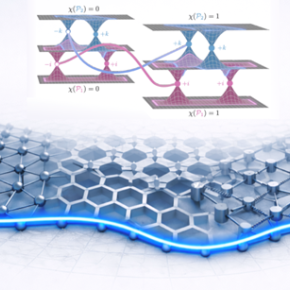
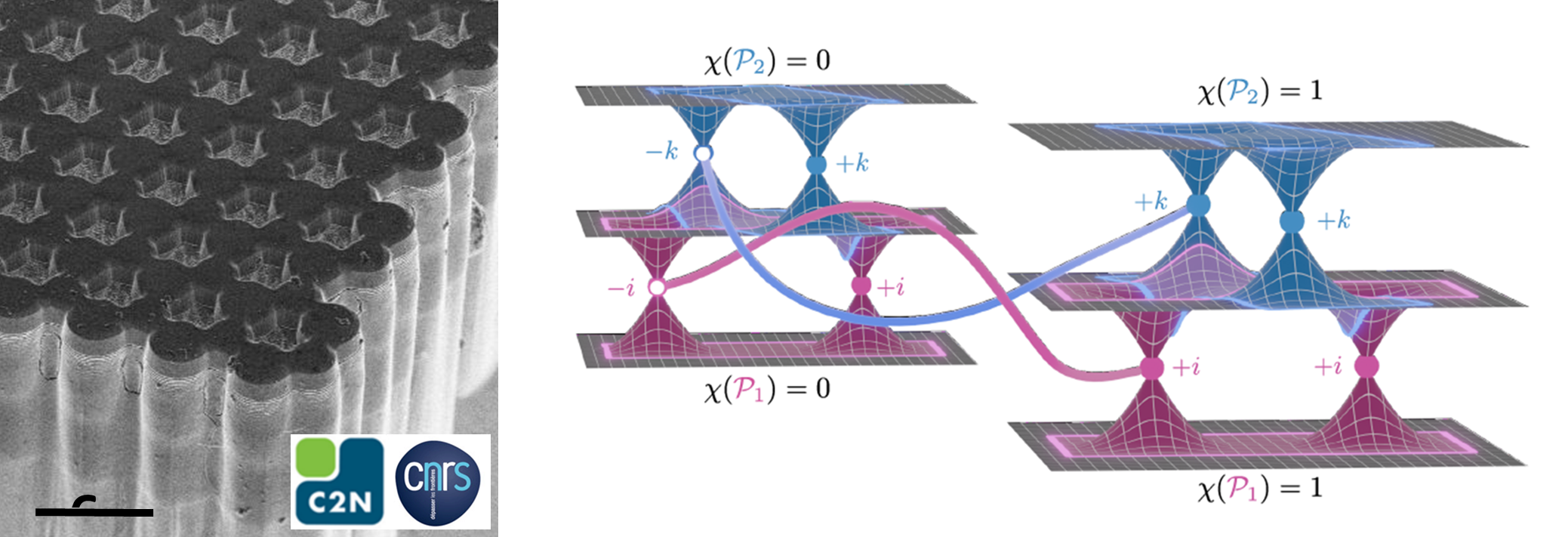
Established in 2026, the Topological Physics research network (PhyTop) is dedicated to studying the emergent topological and geometric properties in classical and quantum physical systems. It brings together 150 scientists working across a wide range of fields, from nanoscience to metamaterials, from photonics to phononics, and from acoustics to fluid dynamics.
The Research Networks (GDR) bring together and mobilize research teams from various disciplines around original or emerging scientific themes. Discover the research networks led by CNRS…
The Topological Physics research network aims to bring together researchers working across a wide range of platforms, at all scales, to study the emergent topological and geometric properties in classical and quantum physical systems. It seeks to develop cross-disciplinary theoretical concepts and tools—drawing in particular on interactions with mathematics—to identify new topological systems, uncover novel topological effects in various physical systems, and exploit these properties within the most suitable experimental platforms.
Topics covered by the Topological Physics research network
Topological properties of classical and quantum waves
Topological defects and obstacles in structures and phases
Mathematics of topological insulators
Non-hermitian and nonlinear systems
Artificial gauge fields
Manipulation of boundary and surface states
A research network in physics at the interface with mathematics
Topological physics interacts closely with mathematics, particularly through K-theory, noncommutative geometry, spectral theory, and semiclassical analysis. This collaboration makes it possible, for example, to rigorously formalize the use of topological indices and to construct new indices for exploring, among other things, nonlinear or non-Hermitian models. The systems encountered in topological physics also serve as a source of inspiration for new problems in mathematics.
Potential applications in photonics, mechanics, and acoustics
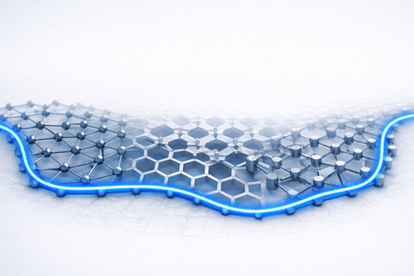
Topological edge channels are robust and insensitive to disorder. Therefore they inspire innovations in photonics (topological lasers, integrated circuits), mechanics (soft robotics, energy harvesting), and acoustics (waveguides, phononic diodes). These technologies could transform, among other things, telecommunications, metrology, quantum sensors, and energy harvesting devices.
G. Theocharis (LAUM)
Research areas that reflect the challenges and opportunities of topology in physics
Beyond crystalline structures, topological physics explores disordered systems, quasicrystals, non-Euclidean geometries, and synthetic dimensions. These approaches make it possible to investigate topological effects in structures with a wide variety of geometric constraints: in dimensions higher than 3, in continuous, inhomogeneous, or even curved media, paving the way for applications that are robust in the face of disorder.
Non-Hermitian topology enables the study of open, dissipative, or amplifying systems, in which the breaking of Hermiticity enriches the topological phenomenology known in solids. Singular points, the non-Hermitian skin effect, and new classes of symmetry offer novel insights into photonic, phononic, and mechanical systems, as well as in fluid dynamics
Interactions and non-linearities transform topological properties, giving rise to solitons, topological phase transitions, instabilities, and emergent collective phenomena. This field holds promise for advances in metamaterials, nonlinear optics, ultracold gases, and, more generally, complex dynamical systems.