
A new international laboratory between the CNRS and European XFEL
European XFEL is the European X-ray free-electron laser (XFEL). To strengthen France's scientific presence within this infrastructure, a new CNRS international research laboratory (IRL) will be created in 2025 alongside this infrastructure. It was inaugurated on Thursday, November 20, 2025, in Schenefeld, where the facility is located.
The CNRS – EuXFEL International Research Laboratory aims to strengthen France's scientific presence within EuXFEL, promote the emergence of original and integrative projects, and provide an environment conducive to scientific excellence. It also addresses the challenge of supporting young researchers by facilitating their access to high-level expertise and optimizing the use of a large international infrastructure, from the preparation of experiments to data analysis.
Free-electron lasers emitting in the X-ray range are used in many disciplines, mainly at the interface between physics, chemistry, and biology. The IRL CNRS – EuXFEL therefore presents research areas focusing on the physics of dilute matter and condensed matter, in the field of high energy density, in physical chemistry, photochemistry, biology, and on topics related to Earth and the Universe.
What is an IRL?
An international research laboratory (IRL) is an international cooperation tool shared by the CNRS, designed to structure highly localized international research collaboration.
IRLs are international research facilities where research activities are carried out jointly around shared scientific themes. They bring together, in a specific location, the significant and long-term presence of scientists from a limited number of French and foreign research institutions (only one foreign partner country).
IRLs have a duration of five years.
This IRL welcomes and supports French researchers in developing their projects at EuXFEL, or within complementary consortia, by providing them with local scientific support. It also provides a network of experts capable of offering advice, technical assistance, and methodological support to enable ambitious experiments to be carried out and high-quality results to be produced. During its first year, this collaboration welcomes five scientists from the CNRS or other French institutions to the European XFEL.
“This new collaboration will further strengthen the already very active and successful French user community at European XFEL. It will contribute to the development of innovative technologies and the resolution of global challenges for the benefit of society, and could also serve as a model for future collaborations with other partner countries,” says Sakura Pascarelli, Scientific Director at European XFEL. “By promoting expertise, this collaboration will further expand the scientific scope and impact of the experiments conducted at European XFEL, while contributing to the long-term development and international reputation of the facility.”
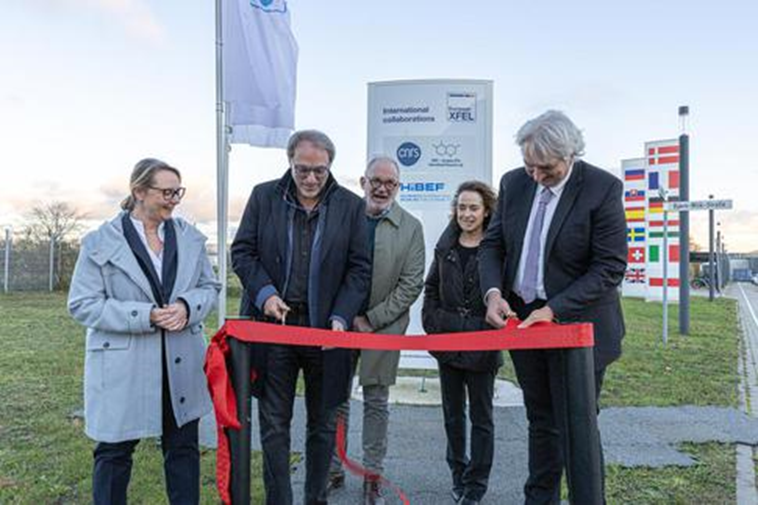
The enhanced cooperation between the two research institutes officially began and became more visible on November 20, 2025, with a ceremony to unveil an inauguration plaque.
This international laboratory is the culmination of the relationship between the French research organization and the European infrastructure since its creation. The CNRS has played a leading role in the design and construction of the superconducting electron accelerator, which is at the heart of this international research infrastructure. A visit by a CNRS delegation to European XFEL at the end of 2024 already highlighted the importance of this infrastructure for the French scientific community.
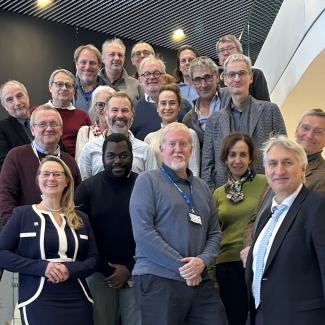
Marc Simon, CNRS Research Director at the Laboratoire de Chimie Physique - Matière et Rayonnement (LCPMR), leads the CNRS-EuXFL IRL. He already coordinated the GDR Science avec les XFEL (XFEL), which brings together the French community of researchers involved in the use of free-electron lasers emitting in the X-ray range. For him, "The new international research laboratory is a tremendous opportunity for the French community of XFEL users to acquire and share the expertise of European XFEL. The long stays of French scientists at European XFEL will enable us to jointly develop innovative instruments and achieve exceptional scientific results."