


Hydrogen atoms reveal interactions at the atomic scale in graphene
Physicists have succeeded in observing diffraction patterns of unprecedented quality by passing fast hydrogen atoms through a sheet of graphene just one atom thick, an experimental and theoretical breakthrough that opens up new perspectives for the study of two-dimensional materials and surface spectroscopy.
References :
Fast Hydrogen Atom Diffraction through Monocrystalline Graphene, Pierre Guichard, Arnaud Dochain, Raphaël Marion, Pauline de Crombrugghe de Picquendaele, Nicolas Lejeune, Benoît Hackens, Paul-Antoine Hervieux, Xavier Urbain, Physical Review Letters 135, 263403 – Published 23 December, 2025.
DOI: 10.1103/wdx6-mrvm
Open access: arXiv
Diffraction, the general tendency of waves to spread out in different directions when passing through an aperture or obstacle, is a well-known phenomenon that affects electromagnetic waves such as visible light and X-rays, among others. Due to their wave nature (predicted by Louis de Broglie in 1923), particles with mass are also susceptible to diffraction, and the first observation of such a phenomenon dates back to 1927 with the diffraction of electrons by metal foils (Thomson and Davisson experiments). In principle, this quantum diffraction also occurs for composite particles (such as the hydrogen atom, composed of a proton and an electron) passing through a material, but observing it represents a significant experimental challenge. When passing through a surface, atoms tend to lose their wave coherence, which erases the diffraction patterns.
The present study was carried out in the following CNRS laboratory:
Institut de physique et chimie des matériaux de Strasbourg (IPCMS, CNRS/Université de Strasbourg)
In a recent study, French and Belgian researchers overcame this difficulty by using very fast hydrogen atoms to probe a suspended graphene monolayer, which had previously been heat-treated to remove impurities and defects, thus preserving the coherence of the atomic beam and the resulting diffraction pattern (see figure below).
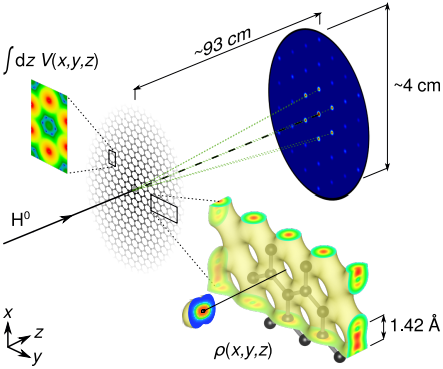
The experiments yielded particularly sharp hexagonal diffraction patterns, direct signatures of the crystalline structure of graphene, and well-defined single-crystal domains. Time-of-flight analysis also made it possible to clearly distinguish elastic scattering events from inelastic processes, further improving the quality of the diffraction images. Comparison between the experimental data and various theoretical models shows that only advanced ab initio calculations based on density functional theory are able to accurately reproduce the observed intensities. The fact that simpler models fail to correctly describe the interaction between the hydrogen atom and the carbon lattice is in itself a major result: it demonstrates that the diffraction of neutral atoms through graphene is an exceptionally sensitive probe of the fine details of interactions at the atomic scale.
Ultimately, this approach could be used to study the effect of defects, mechanical stresses or chemical modifications in two-dimensional materials. It also paves the way for a new form of surface spectroscopy based on the use of neutral atoms, as well as applications in matter interferometry and fundamental physics. These results are published in the Physical Review Letters.