
Expanding the territory explored: a single law to rule them all!
Flips describe the transition of a random walker from one edge of the territory he has already visited to the other. Despite their apparent complexity for walkers with memory, they obey a universal and simple law that applies equally to biological systems and financial markets.
References:
Brémont, J., Régnier, L., Barbier–Chebbah, A. et al. Flips reveal the universal impact of memory on random explorations. Nat Commun (2025). – Publié le 16 décembre 2025
DOI : 10.1038/s41467-025-67139-z
Archive ouverte : arXiv
How can we characterise the way in which a random walk explores its environment over time? From cell movements to stock market index fluctuations, these explorations are traditionally described by the size of the territory visited, whether it is a real spatial domain or a series of values. However, this approach says nothing about how the trajectory changes course: does it continue to push back the same boundary or does it alternate between back and forth movements? For walks with memory, which constitute the vast majority of natural phenomena, this question is all the more difficult because the trajectory depends heavily on the territory already visited.
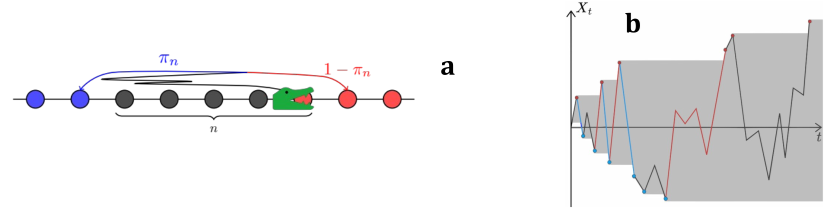
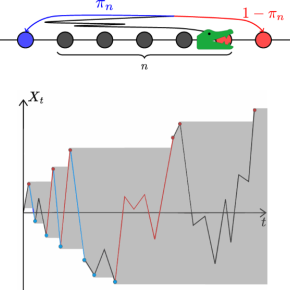
To study this question, physicists have introduced a geometric observable, called flips. To understand this concept, imagine the random walker as an animal visiting a region that is particularly pleasant for it, because it finds food at every step, which it obviously takes the time to eat (see figure (a)). With this image, the territory already visited by the animal is characterised by the fact that it is completely emptied of the food it contained. A flip is an event (extended in time) corresponding to the successive ingestion of food by the animal at two opposite edges of the territory already visited (as opposed to two consecutive ingestions, see figure (b) the penultimate maximum).
The present study was carried out in the following CNRS laboratories:
Laboratoire de physique théorique de la matière condensée (LPTMC, CNRS / Sorbonne Université)
Laboratoire Jean Perrin (LJP, CNRS / Sorbonne Université)
The researchers show that the probability of observing a flip when the visited territory has a size n follows a remarkably simple law: in one dimension, it decreases as 1/n, in a very universal way, because it is independent of the precise details of the walker's exploratory dynamics (and in particular the specific type and extent of memory that its movement mobilises). These details only come into play in a constant that multiplies the factor 1/n, and can therefore be described as the ‘fingerprint’ of the process's memory. The researchers complete the mathematical demonstration of this result by showing concrete verification of this universal law across a wide range of theoretical models and real data: cell migration, DNA sequences, financial indices, etc. By revealing a simple and general structure behind complex exploration behaviours, flips offer a powerful tool for quantifying the exploration of natural or socio-economic processes. This work is published in Nature Communications.