The European Research Council (ERC) has just announced the list of projects that have been awarded a 2025 Advanced Grant. Livia Bove, CNRS researcher at the Institut de minéralogie, de physique des matériaux et de cosmochimie (IMPMC), and Benjamin Sacépé, CNRS researcher at the Néel Institute (NEEL), are both laureates. Their respective projects focus on the dynamics of hydrogen in extreme environments and on the interplay between superconductivity and the quantum Hall effect.
ERC Advanced Grants enable scientists who are recognized in their field at the national and international levels to carry out innovative, high-risk projects that break new ground in their discipline or in other fields. Intended for established researchers, these grants are aimed at researchers with a higher level of experience than those eligible for ERC Starting Grants and ERC Consolidator Grants. These projects, which last for five years, each receive a maximum budget of 2.5 million euros.
The European Research Council (ERC) has just announced the results of the "ERC Advanced grant 2025" call for established researchers. The CNRS is the host institution for 16 grants.
ERC AdG 2025 : SUPERHALL - Superconductivity Meets the Quantum Hall Effect
Superconductivity and the quantum Hall effect are two iconic phenomena in quantum physics, but at first glance they seem incompatible. Superconductivity is based on the collective movement of electron pairs, whereas the quantum Hall effect occurs in strong magnetic fields, which generally destroy superconductivity.
SUPERHALL project aims to overcome this incompatibility. By using very high-quality graphene heterostructures coupled with superconducting contacts, the project will seek to create and control Josephson junctions in which the superconducting current is carried by the chiral edge channels of the quantum Hall effect. These devices will enable the exploration of new hybrid quantum states, where superconductivity, topology, and electronic interactions converge.
Ultimately, SUPERHALL will pave the way for new programmable superconducting circuits based on the quantum Hall effect, with the goal of manipulating exotic excitations—such as anyons—that could play a central role in future topological quantum computing architectures.
HYDRA - Hydrogen Dynamics at ExtrRme Pressure: Advanced Neutron Spectroscopy
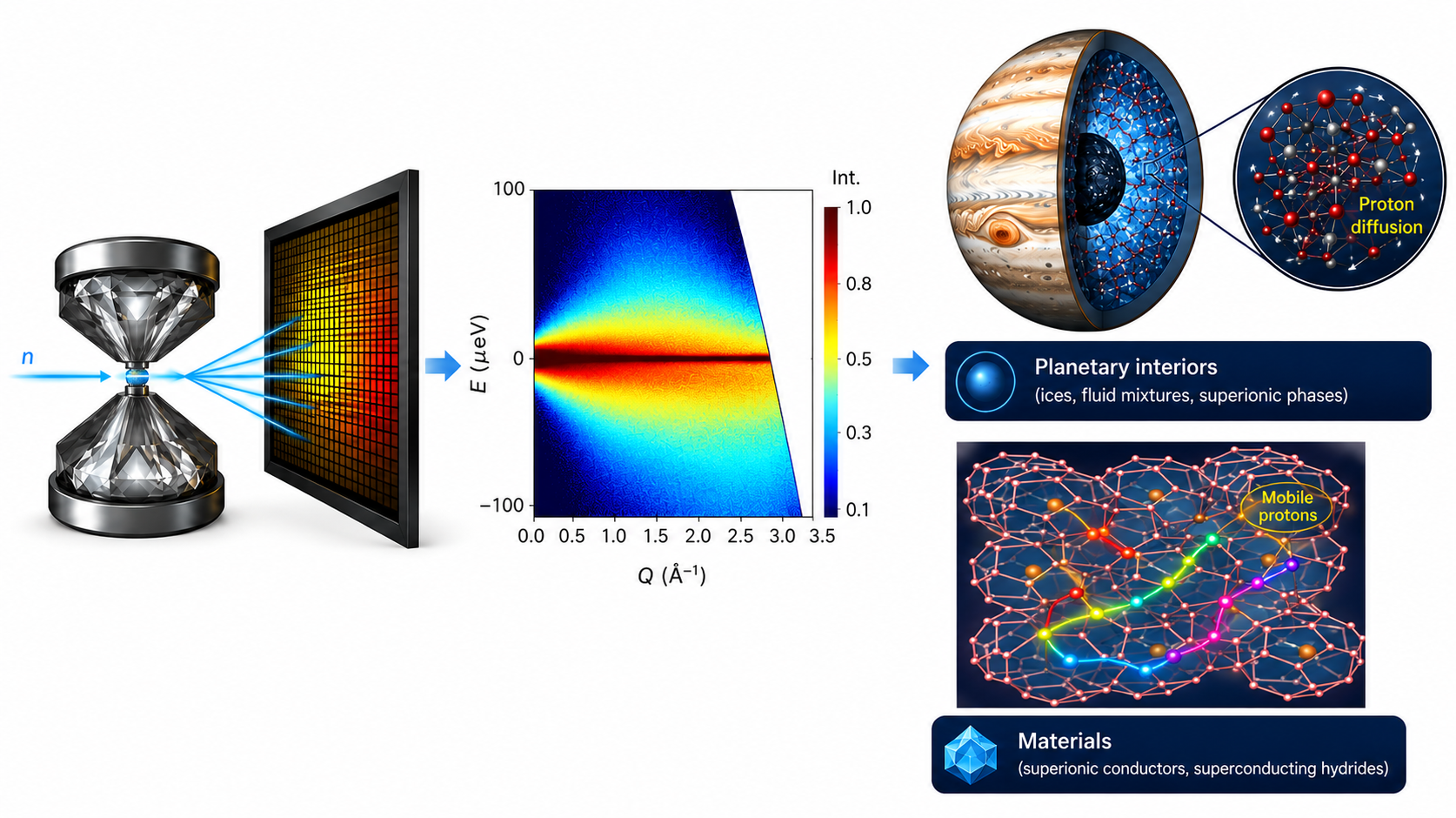
Hydrogen is the most abundant element in the universe, but it is also one of the most difficult to understand and model. Its very low mass amplifies quantum effects, such as zero-point fluctuations, the tunnel effect, and exceptional mobility. Under extremely high pressure, at the cores of giant planets or in certain superconductors with high critical temperatures, these phenomena govern essential properties of matter.
The HYDRA project aims to directly observe, for the first time, the dynamics of hydrogen in these extreme environments. To achieve this, it will develop a new high-pressure cell designed for neutron spectroscopy, enabling this technique to be extended to pressures that were previously unattainable. This breakthrough will provide insight into a fundamental aspect of matter that has largely eluded experimental observation: the motion of protons.
The expected results will provide a better understanding of ices and fluids in planetary interiors, hydrogen-rich materials for energy, and the mechanisms underlying superconductivity in hydrides. By making measurable what until now could only be inferred indirectly, HYDRA will open a new window onto the quantum behavior of hydrogen under pressure.