

Defects in diamonds to probe the structure of superconductors
A team of physicists has shown that the quantum properties of certain defects in diamonds can be used to map the magnetic field around a superconducting sample and detect inhomogeneities in the material at very high pressure.
References :
Imaging the Meissner effect and flux trapping of superconductors under high pressure using N-𝑉 centers, Cassandra Dailledouze, Antoine Hilberer, Martin Schmidt, Marie-Pierre Adam, Loïc Toraille, Kin On Ho, Anne Forget, Dorothée Colson, Paul Loubeyre, et al.,Physical Review Applied 23, 064067 – Published 30 June, 2025.
Doi : 10.1103/PhysRevApplied.23.064067
Open access archives : arXiv
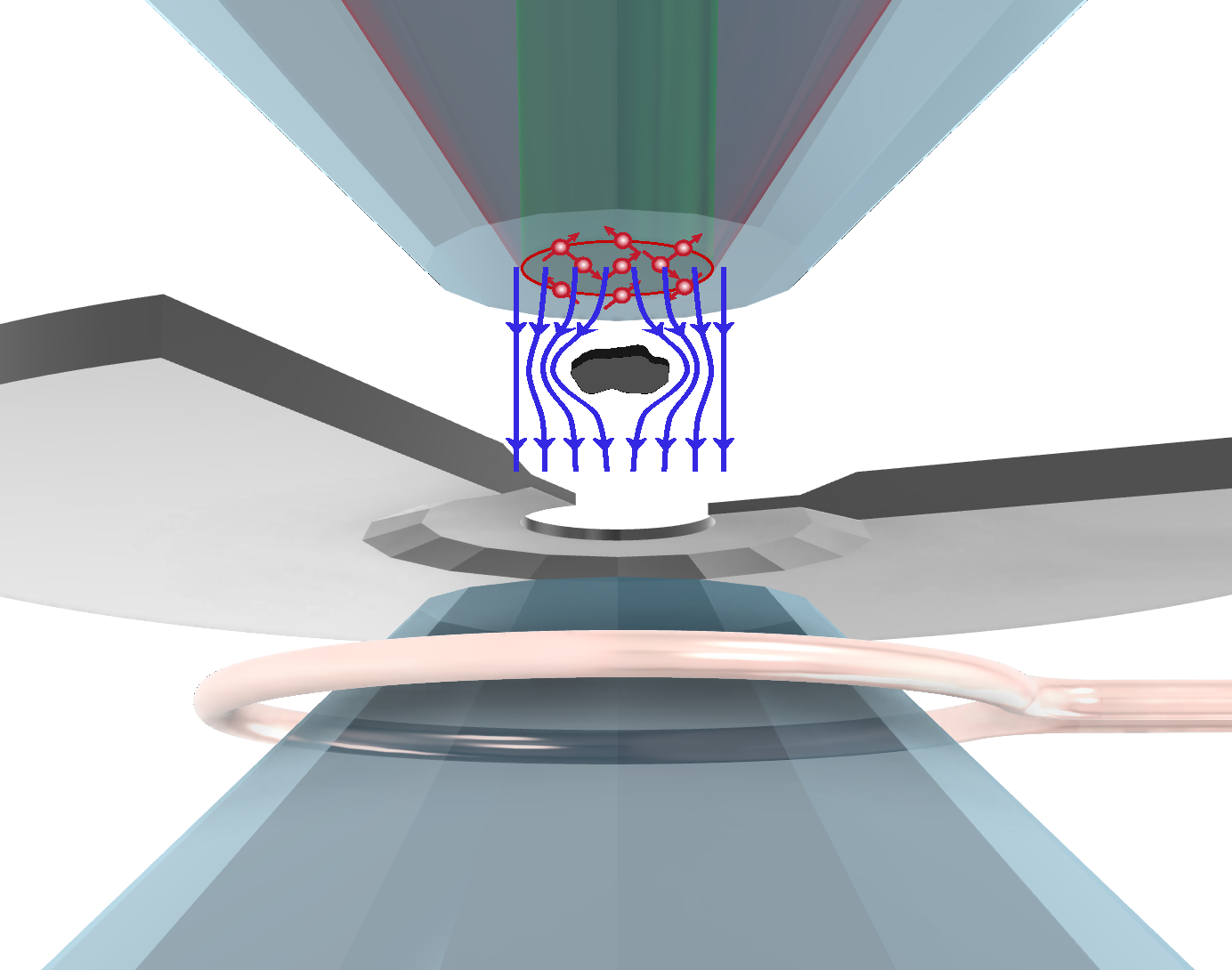
Pressure is a crucial parameter that can be modulated to study the superconducting phases of a material. However, the devices used to achieve extreme pressures (necessary because a solid is by nature nearly incompressible), diamond anvil cells, can only accommodate micrometric-sized samples, making it difficult to use traditional methods for observing superconductivity, which are suited to larger samples. To overcome these limitations, the team from the Lumière-Matière aux Interfaces (LUMIN) laboratory introduced a new method in 2019 to observe the expulsion of a static magnetic field from inside the superconductor (the Meissner effect, an experimental signature of superconductivity). This method is based on the introduction of N-𝑉 centres (or ‘nitrogen-vacancy’ centres) on the tip of one of the two diamond anvils. These are localised defects in the diamond structure in which two neighbouring carbon atoms are replaced, one by a nitrogen atom (N) the other by a vacancy (V). The sensitivity of these defects, which behave spectroscopically like artificial atoms, gave researchers the idea of using them as nanoscopic quantum sensors under the extreme pressure conditions of the experiments, thus providing access to mapping the deformation of the magnetic field lines around the sample.
The present research was conducted in the following CNRS laboratories:
Laboratoire Lumière-Matière aux Interfaces (LUMIN, CNRS/ENS Paris-Saclay/Université Paris-Saclay)
Service de physique de l'état condensé (SPEC, CEA/CNRS)
Building on this approach, the team has once again demonstrated the effectiveness of this method in a study conducted in collaboration with CEA-DAM. Using rapid and robust data analysis techniques, the researchers measured the distribution of the superconducting critical temperature within the sample with micrometric resolution. To achieve this, the physicists placed a sample of Hg-1223, a mercury-based cuprate synthesised at Service de physique de l'état condensé (SPEC), inside a diamond anvil cell cooled to around 100 kelvins and then applied a magnetic field. By analysing the light emitted by the N-𝑉 centres, they mapped the intensity and orientation of the magnetic field within the sample and showed for the first time that the exceptional resolution of optical imaging of the Meissner effect makes it possible to reveal the heterogeneity of the areas trapping the magnetic field through currents flowing without dissipation.
The LUMIN team now plans to combine this approach with X-ray diffraction measurements that achieve the same spatial resolution on the latest generation of synchrotrons. They hope this will help them to understand how superconductivity appears with increasing pressure, particularly in materials such as nickelates or superhydrides, which are difficult to synthesise and result in samples with highly heterogeneous crystal structures. These results are published in the journal Physical Review Applied.