
When electrons transfer heat to the silicon
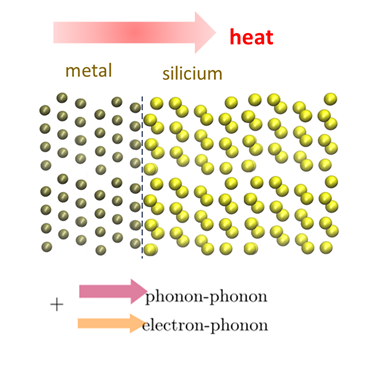
By comparing quantum predictions with experimental results, physicists have shown that heat transfer at metal-silicon interfaces depends not only on phonons but also on electrons.
References
First-principles calculations of thermal transport at metal/silicon interfaces: Evidence of interfacial electron-phonon coupling, Michaël De San Féliciano, Christophe Adessi, Julien El Hajj, Nicolas Horny, François Detcheverry, Manuel Cobian, Samy Merabia, Physical Review B 112, 245303 – Published 15 December, 2025.
DOI: 10.1103/94kx-5l8h
Open access : arXiv
Understanding heat transfer at metal-semiconductor interfaces is crucial in microelectronics. For electronic devices to function properly, it is essential to prevent the formation of hotspots, which can cause them to malfunction or fail. For example, when their internal temperature exceeds a certain threshold, our mobile phones automatically switch from 5G to 4G. Hot spots generally occur within chips that contain a very high density of transistors in contact with metal heat sinks. Heat must therefore be efficiently dissipated from the silicon chips – a semiconductor – to the metal heat sinks. Due to the very high density of interfaces and nanometric dimensions, bulk thermal resistance processes are negligible. It is the thermal resistance at the metal/semiconductor interfaces that dominates heat transfer here.
Certain cancer therapies assisted by metallic nanoparticles also involve heat transfer at metal/semiconductor interfaces. In this process, the metal nanoparticles heat up under the effect of laser excitation. The use of heterogeneous metal-silica core-shell nanoparticles allows them to be heated using infrared radiation, as this is a wavelength range through which living tissue is transparent. Here again, understanding heat transfer at metal/semiconductor interfaces is essential for optimising these applications.
The present study was carried out in the following CNRS laboratories:
Institut Lumière Matière (ILM, CNRS/Université Claude Bernard Lyon 1)
Laboratoire de tribologie et dynamique des systèmes (LTDS, CNRS/École Centrale de Lyon/ENTPE)
From a fundamental perspective, the thermal resistance of metal/semiconductor interfaces has been studied experimentally for two decades. The vast majority of these experiments have been interpreted using various theoretical models, all of which, however, rest on a common assumption: it is the phonons – the collective vibration modes of materials – that govern heat transfer at interfaces. In this approach, electrons, although they are the energy carriers within the bulk of metals, play only a secondary role. However, by comparing quantum predictions with experimental measurements, a group of physicists from the iLM (CNRS, University of Lyon), in collaboration with the LTDS laboratory (CNRS, École Centrale de Lyon) and the University of Reims, has been able to demonstrate that heat transfer at the metal-silicon interface involves not only phonons but also electrons. Unlike the atomistic simulations used to date, the researchers employed ab initio quantum calculations, which allowed them to move beyond empirical potentials and fully account for the role of electrons. Until now, the effect of electrons had either been entirely neglected or considered only phenomenologically.
These quantum calculations have shown that the parameter controlling the coupling between the metal’s electrons and the semiconductor’s phonons is the metal’s Debye frequency, which is related to the material’s elastic modulus. These findings thus provide a microscopic understanding of the mechanism by which electrons in a metal transfer heat to a semiconductor. By revealing the fundamental mechanism of heat transfer at the metal/semiconductor interface, these results pave the way for better management of heat fluxes, whether for regulating hotspots within microelectronic devices or optimising the nanoparticles used in thermal cancer therapies. This work is published in the journal Physical Review B.