


Towards the optimisation of spin-chain-based quantum materials
Researchers have for the first time measured the decoherence mechanisms of topological quantum states in organic spin chains.
References :
Exploring electron spin dynamics in spin chains using defects as a quantum probe. Loic Soriano, Achuthan Manoj Kumar, Guillaume Gerbaud, Adrien Savoyant, Remy Dassonneville, Hervé Vezin, Olivier Jeannin, Maylis Orio, Marc Fourmigué, Sylvain Bertaina, Nature Communications 17, 4046 - Published: 17 March 2026.
DOI: 10.1038/s41467-026-70589-8 (article in open acces)
Quantum technologies rely on the existence of objects — atoms, ions, crystal defects — capable of maintaining a coherent quantum state for long enough to be manipulated. However, interactions with the environment inexorably degrade these organised quantum states: this is decoherence, a natural phenomenon that constitutes a major obstacle to the development of these technologies. Current strategies mainly aim to isolate the quantum information carrier from its environment as much as possible, for example by diluting it in a very pure crystal or cooling it to extreme temperatures. A recent and promising approach to preventing decoherence could be to use so-called topological quantum states, which, for reasons of symmetry, are naturally protected against external couplings.
The present study was carried out in the following CNRS laboratories:
- Institut Matériaux Microélectronique Nanosciences de Provence (IM2NP, Aix-Marseille Université/CNRS/Université de Toulon)
- Laboratoire Avancé de Spectroscopie pour les Interactions, la Réactivité et l'Environnement (LASIRe, CNRS/Université de Lille)
- Institut des sciences chimiques de Rennes (ISCR, CNRS/ENSCR/Université de Rennes)
- Bioénergétique et ingénierie des protéines (BIP, Aix-Marseille Université/CNRS)
- Institut des Sciences Moléculaires de Marseille (iSm2, Aix-Marseille Université/CNRS/Centrale Méditerranée)
Researchers have revealed for the first time the microscopic mechanisms governing the coherence of topological quantum states in organic spin chains, and have shown that collective correlations within these chains significantly reduce the effect of external perturbations. The scientists studied organic crystals of the (o-DMTTF)₂X family (where X is either Cl (chlorine), Br (bromine) or I (iodine)), in which stacked molecules form true one-dimensional magnetic chains. Below 50 K, these chains dimerise and become magnetically silent (see the alternation of up and down spins in the figure), with the exception of defects appearing at chain breaks: these ‘topological edge states’ form clusters of correlated spins, protected from spurious interactions by the system’s global symmetry (see figure).
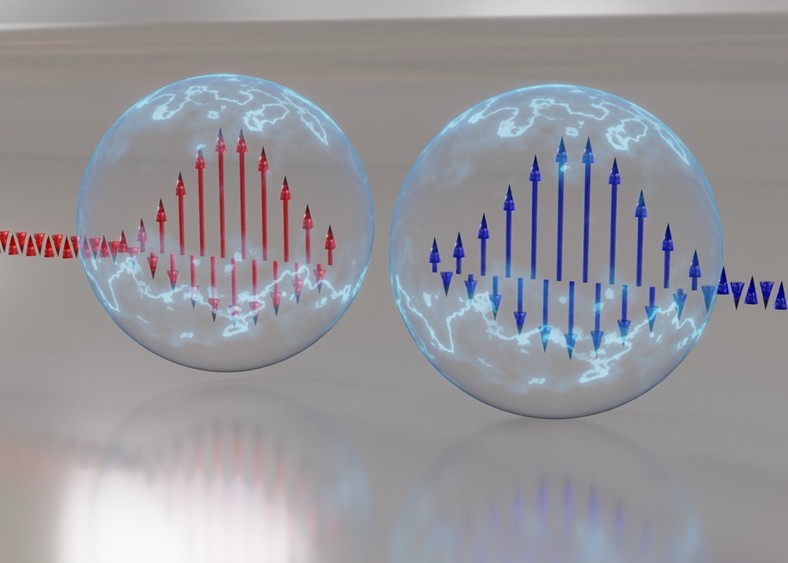
Using electron paramagnetic resonance (EPR), the researchers measured the relaxation and coherence times of these edge states with unprecedented precision. The main conclusion of the work is surprising: the effective dipole field between defects, which is usually the main source of decoherence, is reduced by more than 80% compared to that of isolated spins of the same concentration, which increases the coherence times by the same amount. These results provide some guiding principles for optimising coherence in future materials, and are, for example, directly relevant to recent realisations of topological edge states in atomically precise nanographene structures, where the internal dipole field could constitute the ultimate limit to decoherence. More generally, this study demonstrates that many-body correlations in topological systems can provide intrinsic protection against environmental decoherence. This work is published in the journal Nature Communications.