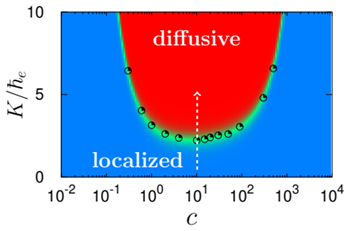


Together they restore chaos!
Researchers have recently demonstrated a new form of transition between an “insulating” and a “conductive” state in a quantum gas subjected to periodic pulses, a result that sheds new light on the effects of interactions in the dynamics of quantum systems.
References :
Interaction Induced Anderson Transition in a Kicked One Dimensional Bose Gas, Hazel Olsen, Pierre Devillard, Gianni Aupetit-Diallo, Patrizia Vignolo, Mathias Albert, Physical Review Letters 135, 173403 – Published 22 October, 2025.
DOI : 10.1103/dyxq-qkmd
Open access : arXiv
Since the discovery of Anderson localization in the 1950s, physicists have been striving to understand how quantum interference can block the propagation of particles in a disordered medium. While this mechanism is well understood for independent particles, its behavior in the presence of interactions remains one of the great mysteries of quantum physics. This problem, which is at the heart of much theoretical and experimental research, is currently being addressed by laboratories around the world, thanks in particular to advances in the manipulation of ultracold gases.
The present study was carried out in the following CNRS laboratories:
Institut de physique de Nice (INPHYNI, CNRS/Université Côte d'Azur)
Centre Physique Théorique (CPT, Université Aix-Marseille/ CNRS/Université de Toulon)
In a recent theoretical study, a Franco-Italian collaboration bringing together several researchers studied a one-dimensional gas of atoms subjected to “kicks”—brief pulses repeated over time (which are generally produced experimentally by light pulses). They showed that, unlike in the case without interactions where the dynamics of the system remain frozen, interactions between particles can trigger a transition to a state where the pulses given to the system cause the energy to increase again. This interaction-induced “dynamic Anderson” transition (where the role of structural disorder is played by the chaotic dynamics of the system) is all the more surprising because, unlike the usual order-disorder transitions, where the dimensionality of space is critically important, here this critical role is played by the number of interacting particles. By combining exact calculations and numerical simulations, the team established a formal link between this system and canonical models of electronic conduction. These results, which open up new perspectives on understanding the role of interactions, disorder, and chaos in the dynamics of quantum systems, are published in the Physical Review Letters.