
Spins under pressure: towards a quantum liquid state
A team of researchers has demonstrated that, under pressure, a magnetic compound is capable of transitioning from an ordered magnetic state to a rare quantum state known as a spin liquid.
References:
Emergence of a Fluctuating Ground State in Y-Kapellasite under Pressure. Dipranjan Chatterjee, Petr Doležal, Federico Abbruciati, Tobias Biesner, Katharina M. Zoch, Rustem Khasanov, Shams Sohel Islam, Guratinder Kaur, Seulki Roh, Francesco Capitani, Joao Elias F. S. Rodrigues, Gaston Garbarino, Cornelius Krellner, Philippe Mendels, Edwin Kermarrec, Martin Dressel, Björn Wehinger, Andrej Pustogow, Fabrice Bert, Pascal Puphal, Physical Review Letters 136, 136701 - Published 30 March, 2026.
DOI: 10.1103/3pmg-b78n (article available in open access)
Spin liquids are exotic states of quantum matter. Despite strong exchange interactions, the spin ensembles in these states neither order themselves nor freeze (even at absolute zero), but form long-range entangled quantum states. Understanding the exact nature of these fascinating states constitutes a major theoretical challenge in condensed matter physics, and their realisation in actual materials – which inevitably deviate from theoretical models – remains a subject of debate.
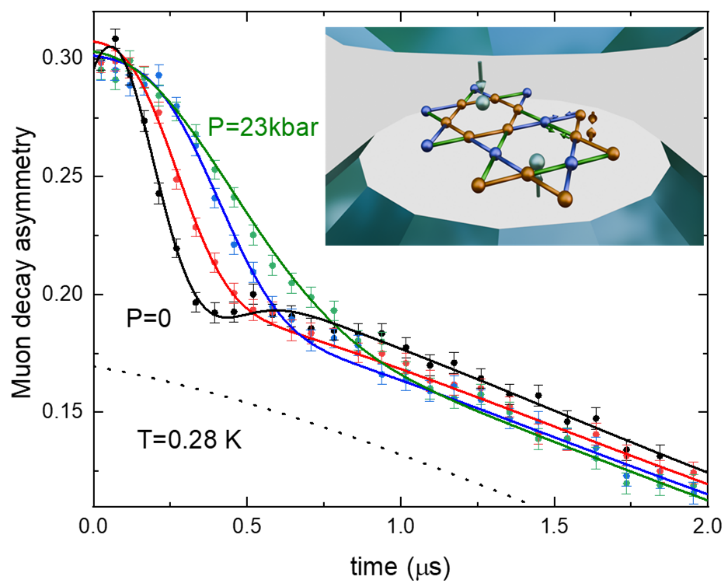
However, the antiferromagnetic compound Y-kapellasite (Y₃Cu₉(OH)₁₉Cl₈) is a particularly interesting system in this regard, as it exhibits a Kagome-type magnetic structure with no substitution defects (see inset in the figure). At ambient pressure, the slight distortion of its Kagome lattice partially reduces the magnetic frustration, leading to the emergence of a magnetic order below 2.2 K. Previous work has nevertheless shown that this material is close to a spin liquid phase. This therefore makes the material an ideal system for addressing a central question in frustrated magnetism: is it possible to suppress the magnetic order and obtain a quantum fluid by modulating only the frustration, without introducing disorder?
This research was carried out in the following CNRS units:
Laboratoire de Physique des Solides (LPS, CNRS / Université Paris-Saclay)
Synchrotron SOLEIL
Using muon spectroscopy under hydrostatic pressure, an international team of researchers has observed that the static magnetism present at ambient pressure disappears completely at 23 kbar (see figure). At this pressure, the spins remain dynamic down to the lowest temperatures measured, with no sign of spin freezing. Complementary measurements using high-pressure X-ray diffraction and infrared spectroscopy reveal that this change is not due to a structural phase transition (a topographical change in the lattice), as the Cu–O magnetic lattice remains essentially intact. The role of pressure is to gradually reduce the anisotropy of the Kagome lattice, thereby increasing magnetic frustration.
In many materials where a quantum spin liquid phase is likely to emerge, the presence of disorder generally complicates interpretation, as disorder induces experimental signatures similar to those expected for a spin liquid. In the Y-kapellasite compound, however, the fluctuating state is stabilised in pure single crystals under the influence of a controlled external parameter. This study therefore establishes this compound as a rare model system, in which long-range order is suppressed by pressure-controlled frustration, offering a particularly promising avenue for the study of a disorder-free quantum spin liquid. These results have been published in the Physical Review Letters.