

Simulation of the early universe in a Bose-Einstein condensate
By periodically disturbing a cold gas of helium atoms with a laser, physicists have succeeded in creating excitations from the quantum vacuum, using a process similar to the creation of matter in cosmology.
References
Observation of Entanglement in a Cold Atom Analog of Cosmological Preheating, Victor Gondret, Clothilde Lamirault, Rui Dias, Léa Camier, Amaury Micheli, Charlie Leprince, Quentin Marolleau, Jean-René Rullier, Scott Robertson, Denis Boiron, Christoph I. Westbrook, Physical Review Letters 135, 240603 - Published 11 December, 2025.
DOI: 10.1103/h7ws-g9z2
Open access: arXiv
In quantum field theory (our best description of particle physics), “empty” space is never truly empty. Instead, it is teeming with fluctuations, tiny oscillations that can transform into particles if activated by a physical process. One such possible process is parametric amplification, a resonant response to a multiplicative oscillation, a phenomenon often encountered in physics, for example in the generation of waves on the surface of a vibrating liquid or to explain the creation of particles in the early universe.
The present study was carried out in the following CNRS laboratories :
Laboratoire Charles Fabry (LCF, CNRS / IOGS)
Physique et Ingénierie en Matériaux, Mécanique et Énergétique (Institut P', CNRS)
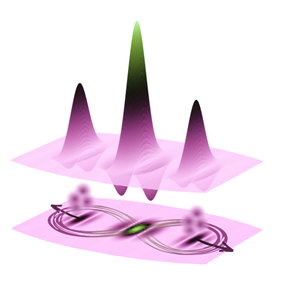
In a recent experiment, physicists created such a parametric resonance experiment in an ultra-cold helium gas (25 nanoKelvin above absolute zero), held in place by laser beams. The intensity of a laser is modulated over time to induce an oscillation in the gas and trigger parametric amplification, leading to the creation of phonons (gas excitations), which has been clearly observed experimentally (see figure). However, since the phonons already present due to the non-zero temperature of the gas are also amplified, the researchers carried out an additional verification, necessary to certify that the vacuum fluctuations had indeed served as the seed. The proof was provided by showing that the phonons are created in entangled pairs, i.e., with correlations too strong to be described by classical physics (non-quantum) physics. The observation of this entanglement, predicted theoretically, had never before been achieved experimentally. The good agreement observed by the researchers between theory and experiment thus validates the use of this experimental system as a quantum simulator to study the dynamics resulting from parametric resonance.
The results of this experiment pave the way for studying the behavior of gas when the phonons created become numerous and begin to interact with each other. This regime is particularly interesting because it has strong analogies with the thermalization of particles in the early universe, but remains difficult to describe analytically. This work is published in the Physical Review Letters.