
Reconciling the Standard Model with the muon anomaly
A new calculation, combining numerical simulations and experimental data, reconciles the Standard Model with the measurement of the muon magnetic anomaly, a discrepancy that has persisted for thirty years.
References
Hybrid calculation of hadronic vacuum polarization in muon g − 2 to 0.48%, A. Boccaletti, Sz. Borsanyi, A. Cotellucci, Michel Davier, Zoltan Fodor, F. Frech, A. Gérardin, D. Giusti, A.Yu. Kotov, Laurent Lellouch, Th. Lippert, Alessandro Lupo, Bogdan Malaescu, S. Mutzel, A. Portell, A. Risch, M. Sjo, F. Stokes, K.K. Szabo, B.C. Toth, Gen Wang, Z. Zhang, Nature - Published: 22 April 2026.
DOI: 10.1038/s41586-026-10449-z (available in open acces)
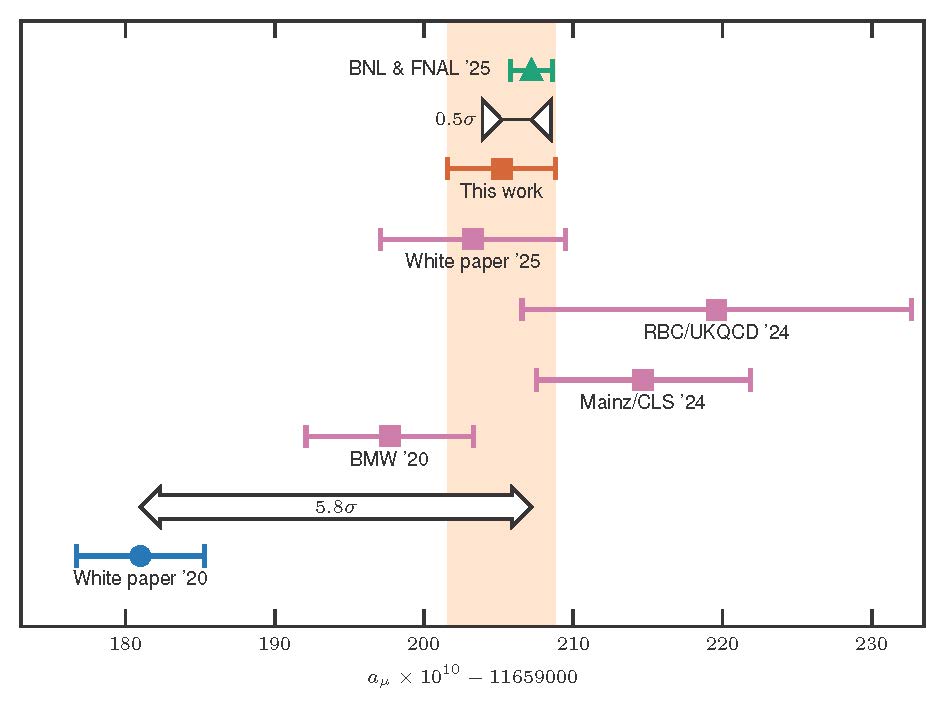
For fifty years, the Standard Model of particle physics has been the cornerstone of our understanding of the subatomic world. It encompasses the description of electromagnetism and the weak and strong interactions, and has provided a single, coherent interpretive framework for particle physics experiments. Yet, for nearly thirty years, one measurement has refused to fit: that of the anomalous magnetic moment of the muon—an elementary particle similar to the electron, but 207 times heavier. This “g-2,” a small quantum correction to the muon’s magnetic properties, has so far resisted any reconciliation with the theory. This discrepancy would have peaked on June 3, 2025, when the Muon g-2 experiment at Fermilab in Chicago concluded its six-year campaign with a measurement of breathtaking precision—127 parts per billion (top—green triangle—in the figure). Compared to the 2020 theoretical reference prediction, the deviation would have amounted to 5.8 standard deviations (see figure), exceeding the conventionally accepted threshold for the discovery of new particles or forces.
The present study was carried out in the following CNRS laboratories:
- Centre Physique Théorique (CPT, Université Aix-Marseille / CNRS / Université de Toulon)
- Laboratoire de Physique de l’Ecole Normale Supérieure de Paris (LPENS, CNRS / ENS-PSL / Sorbonne Université / Université Paris Cité)
- Laboratoire de physique des 2 infinis - Irène Joliot-Curie (IJCLab, CNRS / Université Paris-Saclay)
- Laboratoire Physique Nucléaire et Hautes Energies (LPNHE, CNRS / Sorbonne Université)
However, the Budapest-Marseille-Wuppertal (BMW) and Davier-Malaescu-Zhang (DMZ) collaborations have just taken a decisive step: their new calculation of the most uncertain element in the Standard Model prediction—the contribution to the muon’s magnetic moment from quantum fluctuations of quarks, antiquarks, and gluons, known as “hadronic vacuum polarization”—achieves unparalleled precision and is in excellent agreement with the experimental measurement. Their result is 1.6 times more precise than the calculation performed by BMW in 2020 (see figure), which had already suggested that the discrepancy between the measurement and the g-2 prediction might be due to a flaw in previous calculations rather than the emergence of new physics. This earlier result has been corroborated by multiple other independent lattice QCD collaborations (numerical calculation techniques for quantum chromodynamics) around the world, as described in the 2025 white paper of the Muon g-2 Theory Initiative (see “White paper ‘25” in the figure), thereby confirming the lattice approach as the new standard for this calculation.
The new calculation is based on a hybrid approach: it combines extensive lattice QCD simulations—in which the equations of particle physics are solved on extremely fine grids, utilizing some of the world’s most powerful supercomputers—with data from low-energy electron-positron collisions, a domain where all experiments agree. This allows researchers to bypass the problematic discrepancies observed between the various experiments at higher energies and achieve a precision greater than either method could achieve on its own.
The result is a Standard Model prediction that agrees with the measurement to within just 0.5 standard deviations (see the red square at the top of the figure), a dramatic turnaround from the theory-experiment tensions of just a few years ago, and remarkable consistency for a quantity known to eleven significant figures. Uniting the electromagnetic, electroweak, and strong forces into a single prediction of such precision constitutes a major achievement of modern theoretical physics, an epic journey that began in 1947 with Schwinger’s pioneering calculations and has since engaged generations of physicists.
However, some questions remain unanswered. What is the origin of the discrepancies between various electron-positron collision experiments, observed at energies higher than those used in the new calculation? What about the contradictions between some of these experiments and lattice QCD calculations? The BMW and DMZ teams are currently conducting joint studies to answer these questions. Solving these puzzles would not only complete the picture but also yield an even more precise prediction of the Standard Model, fine-tuned enough to match the extraordinary experimental precision already achieved by Fermilab (see figure).
More generally, future experiments, notably Muon g-2/EDM at J-PARC in Japan and MUonE at CERN, as well as new data and analyses from electron-positron collisions and new lattice calculations, will continue to refine this remarkable dialogue between theory and experiment. These results are published in the journal Nature.