

A quantum simulator capable of simulating long-range jumps
Researchers have shown that the optical excitations of a semiconductor-known as excitons-spontaneously form phases without radiative dissipation in nanoscale arrays. This collective effect reflects the emergence of long-range hopping, paving the way for a new class of quantum simulations.
References:
Bose–Hubbard simulator with long-range hopping. Camille Lagoin, Corentin Morin, Kirk Baldwin, Loren Pfeiffer, François Dubin, Nature Physics. 22, 566–570 - Published: 17 March 2026.
DOI: 10.1038/s41567-026-03213-7
Open access: arXiv
By optically exciting a semiconductor, an electron can be promoted from a low-energy state, known as the valence band, to a conduction band state (a free, delocalised electron). The vacancy left in the valence band remains however correlated with the free electron, leading to a bound state, specifically a bosonic quasi-particle known as an exciton. Until now, excitons have mainly been considered in the context of studies of the electronic polarisation of a semiconductor, controlled by Coulombic collisions between excitons.
The present study was carried out in the following CNRS laboratory:
- Centre de recherche sur l'hétéroepitaxie et ses applications (CRHEA, CNRS/Université Côte d'Azur)
By exploring the situation where the exciton fluid is highly diluted, so that collisions become rare, physicists have succeeded in manipulating the optical polarisation that characterises excitonic wave functions. These are indeed affected by coupling with photons, which can induce successive emissions and absorptions of virtual photons. These in turn lead to spatial delocalisation, introducing long-range correlations. A quantum solid with collectively induced phase coherence has thus been observed for the first time.
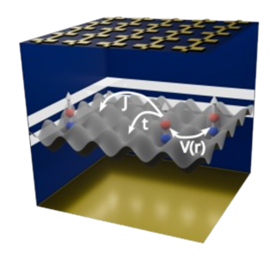
To create exciton quantum solids, the researchers used a stack of two thin (8 nm) semiconductor layers: two GaAs quantum wells fabricated at Princeton University. The excitons are thus composed of an electron and a hole, each confined to a different well. By combining the very high purity of the GaAs bilayer with a specifically developed nanofabrication protocol, the researchers created two-dimensional electrostatic lattices with a period of a few hundred nanometres (illustration). At low temperatures (330 mK above absolute zero), the excitons thus simulate the Bose-Hubbard model with great precision. In this regime, the scientists observed the spontaneous formation of sub-radiative phases, i.e. characterised by a collective suppression of radiative dissipation. In this state, the excitons jump between distant sites in the lattice, a characteristic of their delocalisation. For spatially ordered states, for example in a half-filled checkerboard solid, a single sub-radiant state is macroscopically occupied. Quantum solids thus acquire a phase coherence collectively imparted by long-range hopping. This observation opens up a new avenue for realising exotic phases of quantum matter such as super-solidity, which combines spatial order and superfluidity. These results are published in the journal Nature Physics