

A ‘quantum fish’ swims upstream in a superfluid flow: A new form of propulsion in a fluid of light
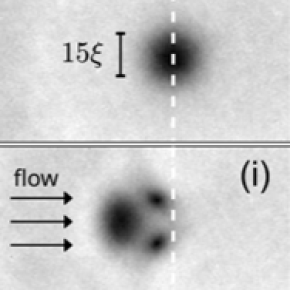
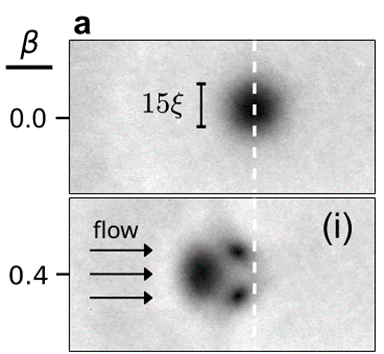
Researchers have observed that a superfluid flowing around an object is capable of setting the object in motion against the direction of the flow if the flow velocity is high enough.
References
Swimming against a superfluid flow: Self-propulsion via vortex-antivortex shedding in a quantum fluid of light, Myrann Baker-Rasooli, Tangui Aladjidi Tiago D. Ferreira, Alberto Bramati, Mathias Albert, Pierre-Elie Larré, Quentin Glorieux. Physical Review Letters. 136, 223401 – Published 3 June, 2026
Doi :10.1103/ndj1-1j89
Archives ouvertes : arXiv
Superfluids are quantum states of certain materials that manifest themselves at the macroscopic level at very low temperatures. They generally exhibit surprising properties and are particularly known for flowing frictionlessly around obstacles as long as their velocity remains below a critical value. Above this threshold, this state breaks down, generally causing objects to be carried along in the direction of the flow.
In a recent study, researchers from a collaboration involving three CNRS laboratories and the University of Porto have uncovered yet another scenario. Using a ‘fluid of light’ – a state in which light behaves like a quantum fluid within an atomic vapour – they analysed the dynamics of a moving obstacle within the fluid. When the fluid’s velocity exceeds the critical threshold, this object spontaneously begins to move against the flow!
This research was carried out in the following CNRS laboratories:
Laboratoire Kastker Brossel (LKB, CNRS / Collège de France / ENS-PSL / Sorbonne Université)
Institut de physique de Nice (INPHYNI, CNRS / Université Côte d'Azur)
Laboratoire de physique théorique et modèles statistiques (LPTMS, CNRS / Université Paris-Saclay)
This behaviour can be explained by the periodic emission of pairs of vortices downstream of the obstacle. By carrying momentum backwards, these vortices generate a thrust in the opposite direction, propelling the object upstream. The researchers were able to observe this phenomenon directly using innovative imaging techniques that allowed them to track both the object’s trajectory and the fluid dynamics. This mechanism is reminiscent of a surprising phenomenon studied in classical hydrodynamics: that of dead trout swimming upstream by passively (so to speak) exploiting the vortices in the flow. Similarly, this ‘quantum object’ does not require its own propulsion system: it utilises the vortices it produces to move.
These results highlight a new form of propulsion, in which energy dissipation becomes a resource rather than a constraint. They open up novel avenues for manipulating and transporting objects on a microscopic scale within quantum fluids. This work has been published in the Physical Review Letters.