Powerful magnetic fields can neutralise stellar flares
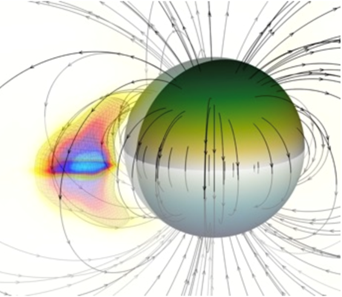
By combining astrophysical simulations with laboratory experiments, a study has demonstrated that intense stellar magnetic fields can completely inhibit the propagation of coronal mass ejections, thereby providing a physical explanation for their absence in stellar observations.
References:
S. N. Chen, K. Burdonov, W. Yao, J. D. Alvarado-Gómez, C. Argiroffi, J. Béard, S. Bolaños, R. Bonito, A. Ciardi, I. Cohen, O. Cohen, J. J. Drake, S. Orlando, Julien Fuchs, Experimental evidence for coronal mass ejection suppression in strong stellar magnetic fields, Physical Review Letters 137, 105201 - Published 4 September, 2026
DOI: https://doi.org/10.1103/hm32-h8q3
Open archive: arXiv
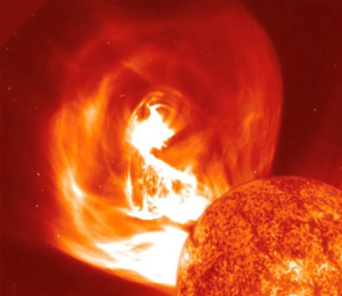
Coronal mass ejections (CMEs) are giant eruptions of magnetised plasma that play a major role in stellar evolution, leading to a loss of mass and angular momentum, and influencing the space weather of orbiting planets. Whilst they are regularly observed on the Sun, conclusive detections around other stars have remained surprisingly rare.
This research was carried out in the following CNRS laboratories:
- Laboratoire pour l'utilisation des lasers intenses (LULI, CNRS / École polytechnique / Sorbonne Université)
- Laboratoire national des champs magnétiques intenses (LNCMI, CNRS)
- Laboratoire d'Étude de l'Univers et des Phénomènes Extrêmes (LUX, CNRS / Observatoire de Paris - PSL / Sorbonne Université)
An international team of astrophysicists and plasma physicists, has just provided an experimental answer to this astrophysical puzzle, demonstrating that the powerful magnetic fields surrounding active stars can completely suppress EMS, thereby helping to explain why they are so rarely observed on the surfaces of stars other than our Sun.
To unravel this mystery, the researchers combined astrophysical simulations, high-energy laser-plasma experiments and advanced three-dimensional magnetohydrodynamic modelling. The team recreated the key conditions of stellar CMEs in the laboratory and observed the behaviour of plasma flows under the influence of increasingly strong magnetic fields. The experiments revealed a clear transition: under weak magnetic fields, plasma currents propagate freely, whilst stronger fields cause them to become unstable, fragment and then come to a complete halt. Numerical simulations have identified magnetic ‘kink’ instabilities as the mechanism responsible for disrupting the plasma and neutralising the ejections. The results obtained in the laboratory correspond closely to astrophysical simulations, showing that a stellar magnetic field of around 100 Gauss can effectively confine CME-type eruptions.
As well as providing a plausible explanation for the lack of observations of stellar EMCs—namely, that they are confined by stellar magnetic fields—these results could also have significant implications for the detection of exoplanets suitable for the emergence of life. CMEs represent an extreme form of stellar space weather and can even strip away planetary atmospheres or alter their chemistry, thereby affecting the long-term habitability of planets. If a large number of EMCs are suppressed by magnetic fields, some exoplanets might be exposed to a less hostile space environment than expected, which would increase their chances of retaining their atmospheres over billions of years. These findings have been published in Physical Review Letters.