Observing femtoscopic droplets at the LHC collider
Scientific news
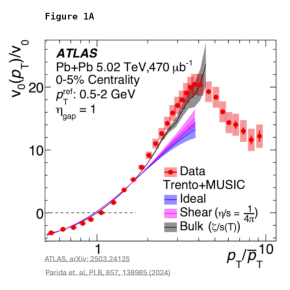
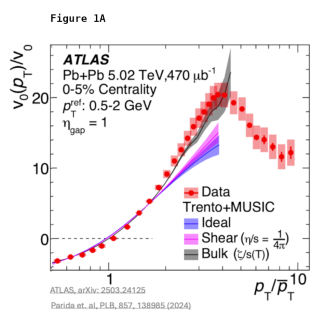
In 2024, theorists at the Institute of Theoretical Physics proposed a method that exploits the small temperature fluctuations from one collision to another to test the validity of the hydrodynamic model applied to the plasmas created at the LHC. The ATLAS and ALICE collaborations implemented this approach and showed that, for each collision, the temperatures measured in different directions are strongly correlated, as expected for a well-formed fluid. The momentum spectrum of the produced particles generally follows the predictions of hydrodynamics, with the notable exception of the fastest particles, which are emitted before the fluid is fully established. These results thus provide concrete confirmation of the connection between theoretical hydrodynamic predictions and experimental observations at the LHC.
The present study was carried out in the following CNRS laboratory:
- Institut de physique théorique (IPhT, CEA / CNRS)
Références :
Probing collectivity in heavy-ion collisions with fluctuations of the pT spectrum, Tribhuban Parida, Rupam Samanta, Jean-Yves Ollitrault, Physics Letters B, Volume 857 - Published 28 August 2024.
DOI: 10.1016/j.physletb.2024.138985
arXiv: https://arxiv.org/abs/2407.17313
- ATLAS Collaboration, « Evidence for the collective nature of radial flow in Pb+Pb collisions with the ATLAS detector ». https://arxiv.org/abs/2503.24125
- ALICE Collaboration, « Long-range transverse momentum correlations and radial flow in Pb−Pb collisions at the LHC ». https://arxiv.org/abs/2504.04796
- Björn Schenke, Chun Shen, Derek Teaney. « Transverse momentum fluctuations and their correlation with elliptic flow in nuclear collision ». Phys.Rev.C 102 (2020) 3, 034905. https://arxiv.org/abs/2004.00690
Contact
Jean-Yves Ollitrault
Directeur de recherche CNRS, Institut de physique théorique (IPhT)
Communication CNRS Physique