


A machine that draws its energy from repeated observation
Physicists have experimentally demonstrated a quantum engine powered not by heat exchange, as in the classical world, but by the inevitable feedback associated with any quantum measurement.
References
R. Dassonneville and C. Elouard and R. Cazali and R. Assouly and A. Bienfait and A. Auffèves and B. Huard, Amplifying microwave pulses with a single qubit engine fueled by quantum measurements, Physical Review Research (2026)
DOI : https://doi.org/10.1103/rygc-bc3c
Open archive arXiv
bserving a quantum system alters its physical state. Known as measurement feedback, this effect lies at the heart of quantum physics. It forces Schrödinger’s cats to become either dead or alive, encodes the results of quantum algorithms in quantum bits, but can also reveal the presence of spies – a feature that could enhance the security of cryptographic protocols based on quantum mechanics. A lesser-known property of measurement feedback is that it is accompanied by changes in energy and entropy, which allows an analogy to be drawn with thermodynamics, where this feedback acts as ‘quantum fuel’.
This research was carried out in the following CNRS laboratories:
- Laboratoire de physique de l'ENS de Lyon (LPENSL, CNRS / ENS de Lyon)
- MAJULAB (CNRS / Université technologique de Nanyang / Université nationale de Singapour / Sorbonne Université / Université Côte d'Azur)
- Laboratoire de l'informatique du parallélisme (LIP, CNRS / ENS de Lyon / Université Claude Bernard Lyon 1)
French researchers, collaborating with the National University of Singapore, have exploited this analogy to operate a new type of quantum machine, based on a superconducting qubit. When the ‘engine’ is switched on, the qubit amplifies the microwave pulse that powers it, resulting in net power being extracted. To make this ‘engine’ work, several experimental challenges had to be overcome. Firstly, the power supplied by a single qubit can be as low as a few zepto-watts (1 zW = 10⁻²¹ W). Secondly, for a measurement to supply energy to the qubit, the quantity observed must not be the qubit’s energy. The physicists therefore measured whether the qubit was in a quantum superposition between the ground state and the excited state. Finally, a feedback control system was implemented to ensure the motor operated cyclically despite the random nature of the measurement results. The complete energy balance of the experiment also makes it clear that the principle of energy conservation is not violated: the energy required to observe the machine was indeed drawn from the mains supply to carry out the measurement
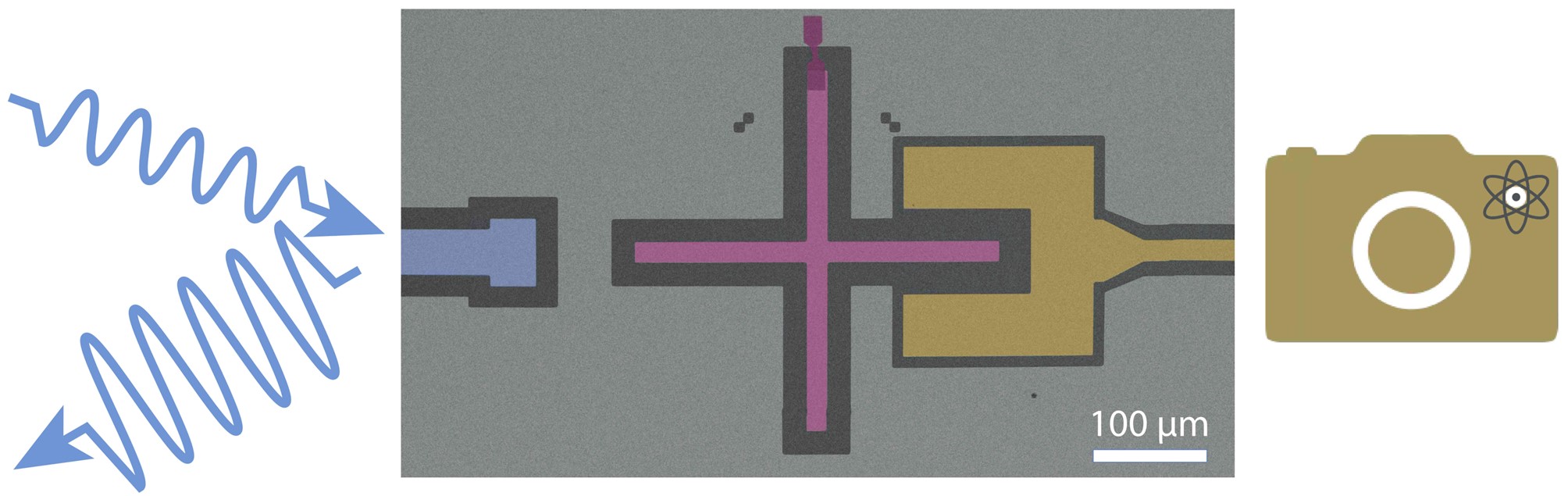
This experiment thus provides direct and quantitative evidence of the energy footprint of quantum measurement, which is not merely a cost but also a resource with highly unusual characteristics, due to the quantum context of the experiment. Exploring these characteristics will shed new light on the problem of measurement, one of the main long-standing open questions in quantum mechanics. This work has been published in the journal Physical Review Research.