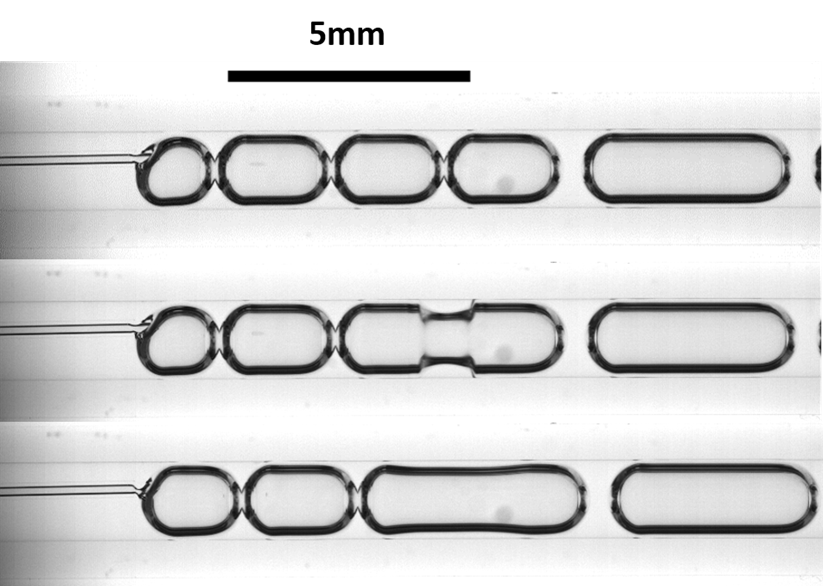


The life expectancy of a bubble in society
In a recent study, researchers precisely quantified the lifetime of contacting bubbles, depending on the composition of the liquid forming the interface and the geometry of the interface.
References
Ange Combrouze, Anjishnu Choudhury, Alexandra Klimenko, Pascal Panizza, Laurent Duchemin, François Lequeux, Emilie Verneuil, Laurence Talini, Tuning bubble coalescence rates over orders of magnitude in liquid mixtures of simple surface thermodynamics: Experiments and theory, PNAS - Published June 9, 2026.
DOI: https://www.pnas.org/doi/10.1073/pnas.2535299123
Open access: HAL
When two bubbles come into contact, they merge very quickly in most pure liquids. When soap or another liquid is added, this process is much slower, and the lifetime of two bubbles in contact can then reach several seconds, or even several minutes. One of the factors responsible for this increase in lifetime is the difference in concentration of the liquid’s various components at the surface and within the bulk of the liquid. Thus, even when the concentration differs by less than one per cent, the lifetime of two bubbles in contact can be multiplied by ten thousand or a hundred thousand! Understanding this increase in lifetimes is therefore crucial for, for example, controlling the stability of foams, which are present in numerous industrial processes and products, ranging from the food industry to cosmetics and oil production.
This research was carried out in the following CNRS laboratories:
- Surface du verre et interface (SVI, CNRS / Saint-Gobain Recherche)
- Institut de physique de Rennes (IPR, CNRS / Université de Rennes 1)
Sciences et Ingénierie de la Matière Molle (SIMM, CNRS/ESPCI Paris-PSL/Sorbonne Université)
- Physique et mécanique des milieux hétérogenes (PMMH, CNRS / ESPCI Paris - PSL / Sorbonne Université / Université Paris Cité)
In a recent study, an international collaboration of researchers, conducted an experiment in which trains of identical, contacting bubbles were formed by injecting gas into a tube filled with liquid. The liquids studied are mixtures of two oils in which the differences in concentration between the surface and the volume can be modified by changing the composition and are well described by simple models. The researchers also varied the size of the tube in which the bubble trains were formed. In all the experiments, the lifetimes of the bubbles were measured precisely, which enabled the validation of a comprehensive physical model in which thermodynamic effects must be incorporated into fluid dynamics to accurately account for the experimental results. These results reveal, for the first time, how geometry and surface thermodynamics modify the process of bubble coalescence upon contact in liquid mixtures. They provide a new basis for predicting the lifetime of bubbles upon contact with other bubbles, regardless of their size. They have been published in the Proceedings of the National Academy of Sciences (USA).