


Keep moving to stay flexible: a new fitness programme for budding gels...
Physicists show in a new study that periodically deforming a gel as it sets allows for precise control of its mechanical properties.
References
Imprinting macroscopic fracture during gelation: A mechanism for tuning colloidal gels. W.J. Smit et al. Physical Review Materials 10, 045602. Publié le 03 avril 2026.
DOI : 10.1103/ng2j-nrfv
Archive ouverte : arXiv
Are you one of those people who shake their yoghurt pot before opening it? Bad idea - or perhaps a brilliant one, depending on what you’re after! Yoghurt, like mayonnaise, toothpaste, fresh concrete or 3D printing inks, belongs to the large family of colloidal gels: soft solids formed by the aggregation of microscopic particles suspended in a liquid. By attracting one another, these particles gradually form a percolated network that traps the liquid and gives the material its mechanical strength. This transition from liquid to solid, also known as the ‘sol-gel transition’, has been studied for decades… but almost always at rest, in the hushed comfort of laboratories. In industrial reality, however, gels rarely form under such ideal conditions: they are poured, spread, extruded, or printed, while being subjected to mechanical deformations that can be significant. How do these perturbations influence the formation of the solid network? The question has remained surprisingly unexplored.
This research was carried out in the following CNRS laboratory:
Laboratoire de physique de l’École Normale Supérieure de Lyon (LPENSL, CNRS / ENS de Lyon)
To answer this, researchers at the physics laboratory of the ENS Lyon studied the formation of a model colloidal gel subjected to high-amplitude oscillatory deformations during its gelation. Their experiments reveal that, beyond well-defined thresholds of deformation amplitude and duration, the forming gel develops a reproducible network of macroscopic cracks. Far from being a simple defect, this damaged microstructure profoundly alters the material’s mechanical properties. While the presence of cracks reduces the gel stiffness, it also increases its ability to dissipate energy and deform before yielding, gradually transforming a brittle response into a more ductile one. The researchers further demonstrate that this complex evolution leaves a remarkably simple signature on the gel’s viscoelastic properties. A minimal extension of the fractional Maxwell model quantitatively captures the effect of damage and establishes a direct link between the presence of cracks and the measured linear mechanical response.
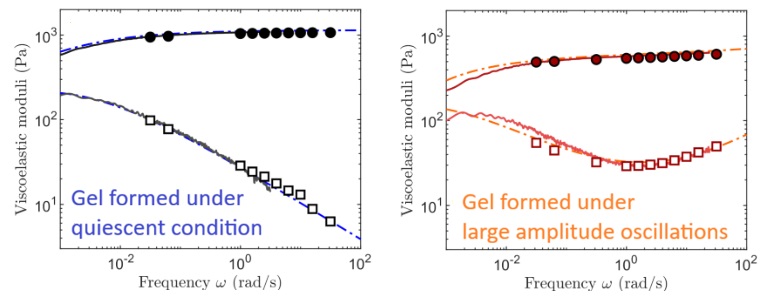
These findings open a new avenue for tailoring the mechanical properties of colloidal gels during processing, with potential applications across a wide range of industrial processes involving soft materials, from moulding to 3D printing. This work has been published in the journal Physical Review Materials and has been selected as an Editor’s Suggestion.