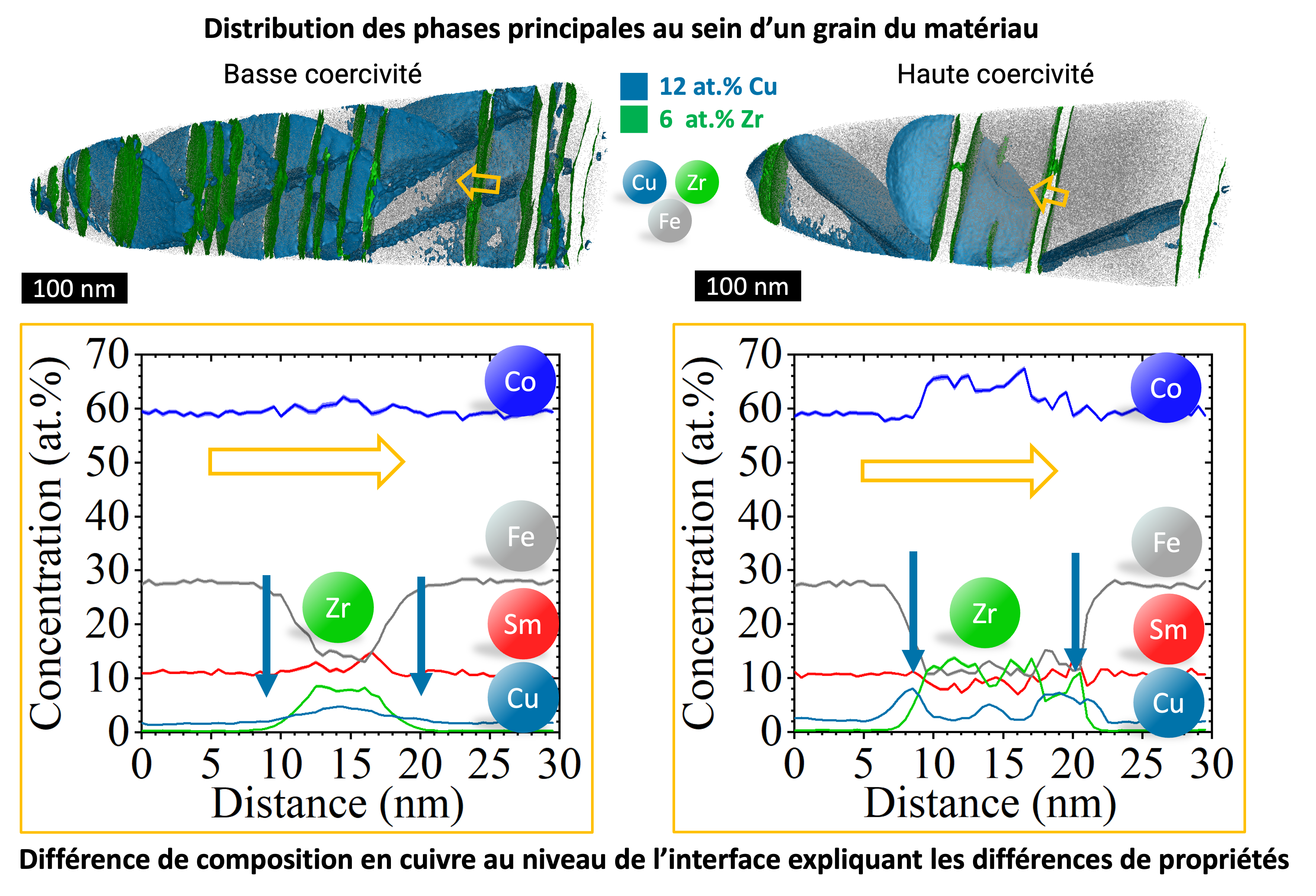


If you want to optimise your magnet, look below the micron scale...
Researchers used correlative microscopy techniques coupled with numerical simulations to show that the optimality of a permanent magnet is determined at the nanometric scale, within each grain of the material.
References
Identifying grain boundary and intragranular pinning centres in Sm2(Co,Fe,Cu,Zr)17 permanent magnets to guide performance optimisation, Stefan Giron, Nikita Polin, Esmaeil Adabifiroozjaei, Yangyiwei Yang, Fernando Maccari, András Kovács, Trevor P. Almeida, Dominik Ohmer, Kaan Üstüner, Alaukik Saxena, Matthias Katter, Iliya A. Radulov, Christoph Freysoldt, Rafal E. Dunin-Borkowski, Michael Farle, Karsten Durst, Hongbin Zhang, Lambert Alff, Katharina Ollefs, Bai-Xiang Xu, Oliver Gutfleisch, Leopoldo Molina-Luna, Baptiste Gault, Konstantin P. Skokov, Nature Communications 16, 11335 - Published 20 December 2025.
DOI: 10.1038/s41467-025-67773-7
Open access: arXiv
Permanent magnets have a crucial role to play in the electrification of our society – for example, in the generation of renewable energy in wind turbines or in electric vehicles. Improving their performance has therefore become a major challenge in the transition to carbon neutrality. In addition, ongoing research and development efforts are seeking to make them more compatible with sustainability and societal and human impact objectives, which partly involves improving the composition and industrial manufacturing conditions of these magnets. However, their properties are due to a very complex arrangement of multiple nanometric phases, both at the interfaces between phases at the atomic scale and in the vicinity of microstructural defects at the scale of hundreds of micrometres, generally grain boundaries, which prevent the magnets from reaching their maximum theoretical performance. In order to continue optimising permanent magnets, it is therefore essential to seek to understand the principles underlying the formation of the microstructure, the nanometric distribution of these complex phases and the magnetic domains, in order to subsequently rationalise their macroscopic properties and thus avoid slow and costly empiricism.
The present study was carried out in the following CNRS laboratory:
- Groupe de physique des matériaux (GPM, CNRS/INSA Rouen/Université de Rouen Normandie)
In a recent article, an international collaboration of researchers studied samarium-cobalt permanent magnets in which 20% of the cobalt was replaced by iron, an element that is more abundant and less critical in terms of resources, but which also modifies the formation and equilibria of the phases of interest. Using a combination of optical microscopy, scanning and transmission electron microscopy to image the micrometric microstructure, the atomic arrangement within the phases and the structure of the magnetic domains, and finally atomic tomographic probing to determine the composition at the nanometric scale, the researchers were able to correlate the microstructural and magnetic information collected at several length scales to guide simulations of magnetic domain displacement. These simulations, in turn, provided access to the prediction of the macroscopic properties of the magnetic material.
Unexpectedly, the researchers discovered that it is not the grain boundaries that limit coercivity – the ‘stability’ of a permanent magnet – but the absence of a few atomic layers of a particular phase (1:5) on the plates of another complex phase (Z), whose role is to magnetically isolate the different magnetic regions from each other. Multi-scale characterisation using a combination of cutting-edge techniques has shown that, in order to obtain optimal magnetic properties, the main focus should be on optimising the microstructure within each grain of the material. This important step has led to improvements in the manufacture of these magnets by using greater homogeneity in their constituent elements, which is critical for certain high-temperature applications or in corrosive environments. These results are published in the journal Nature Communications.