


Generation of indistinguishable photons by laser-controlled resonance of defects in a 2D material
Physicists have controlled the quantum state of a crystal defect artificially created in a material using a resonant laser. This approach has enabled them to generate indistinguishable photons, the building blocks of optical quantum information.
References
Gérard, D., Buil, S., Watanabe, K. et al. Resonance fluorescence and indistinguishable photons from a coherently driven B centre in hBN. Nat Commun 17, 1843 (2026).
DOI : 10.1038/s41467-026-68555-5
Open access arXiv
Hexagonal boron nitride (hBN) is a rather unusual transparent crystal. It belongs to the family of materials known as van der Waals materials, whose atomic layers are weakly bonded to each other. These layers can be manipulated, moved and stacked using specialised techniques. This material can thus be used to create complex devices, with thickness control down to a single atomic layer. It can also be combined with other materials that do not necessarily have the same crystal lattice. This flexibility distinguishes it from more traditional semiconductors such as silicon, diamond and gallium arsenide. In previous studies, a team from GEMaC (CNRS/UVSQ) developed a technique for generating specific crystal defects on demand in hBN using an electron beam. These defects, called colour centres, behave like artificial atoms and can emit single photons, a basic building block of quantum information.
However, to create an efficient quantum processor, the colour centre must then emit photons that are perfectly indistinguishable from one another, i.e. similar in wavelength, polarisation and all other properties. Photons are often generated by exciting the colour centre using a laser with a shorter wavelength than the emission from the defects. Unfortunately, this technique disturbs the environment and consequently degrades the quality of the photons, which can then no longer be used for demanding applications such as quantum information protocols. A better way to control the colour centre is to shine a laser light on it that has exactly the same wavelength as the photons it emits. With this technique, called ‘resonance fluorescence’, unique photons of optimal quality are generated because they disturb the crystalline environment as little as possible, but at the cost of making it much more difficult to observe the emitted photons: they are drowned out by the laser light that is inevitably collected at the same time, which cannot be simply separated by optical filters.
The present study was carried out in the following CNRS laboratory :
Groupe d’étude de la matière condensée (GEMaC, CNRS / UVSQ)
In a recent article, researchers from the GEMaC team cleverly used the polarisation of light – i.e. the direction of vibration of the light wave – to achieve this separation. Single photons have a polarisation determined by the microscopic structure of the colour centre, while that of the laser can be chosen by the experimenters. By setting the polarisation of the laser to a direction slightly different from that of the colour centre, the single photons can then be separated from the laser light using a polariser placed at the output, which acts as a “polarisation filter”. To further optimise the collection of the single photons produced, the researchers also used a layer of silver placed directly under the hBN crystal (Figure 1), with the silver and hBN film directing the photons towards the objective lens of the microscope observing them.
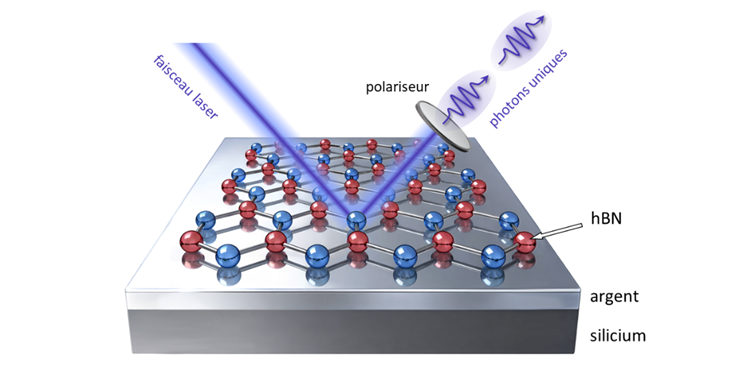
Using this approach, the researchers were able to identify several regimes bearing the signature of purely quantum effects. When the laser is continuous and high-powered, it becomes quantum-entangled with the emitter, producing a very distinctive spectral signature known as a ‘Mollow triplet’, i.e. the appearance of a new emission peak on either side of the emission line of the coloured centre. In addition to this observation, the team also showed that the degree of indistinguishability of the photons produced was extremely high, a promising result for the use of these photons in quantum technologies.
Although hBN is not the first material used as a basis for the production of indistinguishable photon emitters, it offers specific technological advantages. In particular, colour centres can be created in large numbers and at controlled positions. In addition, they all emit at the same wavelength, which is a challenge for other previous platforms, such as InGaAs quantum dots. These results thus open up promising avenues of exploration for the creation of large-scale complex devices. In the long term, the team aims to build complex demonstrators to establish the application potential of this approach for the manufacture of a quantum computer based on indistinguishable single photons. These results are published in the journal Nature Communications.