The European strategy on research infrastructures includes the FOREST project
On June 23, 2026, ESFRI approved six new projects for its 2026 roadmap, including three from France. Among them, the FOREST optical fiber project is the world's largest time-frequency network.
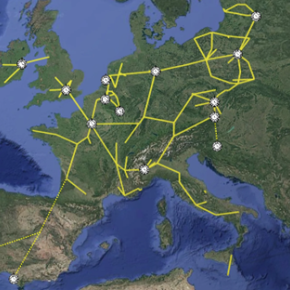
Managed by CNRS, with support from Sorbonne Paris Nord University, the Fiber-based Optical netwoRk for European Science and Technology (FOREST) project is developing an optical fiber network to distribute time-frequency signals with unprecedented precision (a 4 to 5 order of magnitude improvement over GPS). Today, FOREST represents an ever-expanding optical network with a cumulative length already exceeding 31,000 km, making it the world's largest time-frequency network. This project will strengthen European sovereignty in critical fields such as quantum communications, seismology, and infrastructure monitoring.

CNRS Physics - A + A Contact(s) Sylvain Ravy Denis Morineau Lien(s) La recherche à CNRS Physique Share this content Share on Bluesky Share on Twitter Share on Linkedin Share on FaceBook Send by mail https://www.inp.cnrs.fr/en/res
Three French Projects Selected for the ESFRI 2026 Roadmap
The European Strategy Forum on Research Infrastructures (ESFRI) brings together the European Commission and the governments of EU member states and associated countries to define a common strategy for research infrastructures in Europe. On June 23, 2026, ESFRI approved six new projects for its 2026 roadmap, three of which are led by France: FOREST, JERICO, and INSYLVA. JERICO, led by Ifremer, is also supported by the CNRS.

France strengthens its key role in European research infrastructures.
Contacts
Christian Chardonnet
CNRS Research Director at the Laboratoire de Physique des Lasers (LPL) and Coordinator of the REFIMEVE Research Infrastructure
Sylvain Ravy
Deputy Scientific Director « Research Infrastructures »