

ERC Consolidator Grant 2025: grants hosted by the CNRS
Discover all of the ERC CoG 2025 grants hosted by the CNRS.
The European Research Council (ERC) has just announced the list of projects that have been awarded a 2025 Consolidator Grant. Three physicists from laboratories affiliated with CNRS Physics are among this year's winners. Find out more about the projects below.
Discover all of the ERC CoG 2025 grants hosted by the CNRS.
To develop quantum technologies, one must be able to stabilize and manipulate quantum coherence and information in non-equilibrium quantum many-body systems. State-of-the-art approaches are based on correcting many-body errors to stabilize coherence and dynamics, but quantum technologies, such as fault-tolerant quantum computing, have still not been achieved. A recent breakthrough discovery of algebraic principles that determine quantum many-body dynamics by the PI has the potential to form a basis for a theoretical guide for designing quantum many-body systems that have robustly stable quantum coherence and information properties. Systems designed via this algebraic principle would form a stable phase of dynamical matter significantly departing from existing approaches. The goal of the project is a framework for designing quantum systems that feature robust emergent quantum coherence and dynamics, as well as methods for the manipulation of these systems based on aforementioned algebraic principles. The research in the long-term has the potential to significantly alter and speed up the development of emerging quantum technologies.

Berislav Buča is a CNRS resarcher at the Laboratoire de physique théorique et modèles statistiques (LPTMS, CNRS / Université Paris-Saclay)
Atomic nuclei are the core of all visible matter and are composed of nucleons. Nucleons are made up of quarks and gluons, which cannot be isolated due to confinement. When we try to answer fundamental questions such as “what is the origin of the mass and spin of the nucleon?”, we know that the answer lies in Quantum Chromodynamics (QCD), the theory describing the strong interaction within the Standard Model (SM). However, the non-perturbative nature of QCD makes this answer extremely difficult to obtain.
Yet, despite the formidable difficulty of the task, great progress has been made in ab initio calculations of maps describing the structure of nucleons. Starting from the simpler 1D case, we have been able to study, using lattice QCD simulations, the parton distribution functions (PDFs) of quarks and gluons, paving the way for the extraction of 3D maps, called generalized parton distributions (GPDs).
The objective of HADaSTRaLS is the first high-precision ab initio extraction of the PDFs and GPDs of quarks and gluons in the nucleon, with full consideration of systematic effects. The goal is to use these results to foster collaborations with phenomenology towards a new paradigm in which parton distributions are obtained from experimental and simulated data.
Savvas Zafeiropoulos is a CNRS researcher at the Centre de physique théorique (CPT, CNRS/Aix-Marseille Université/Univ. Toulon)
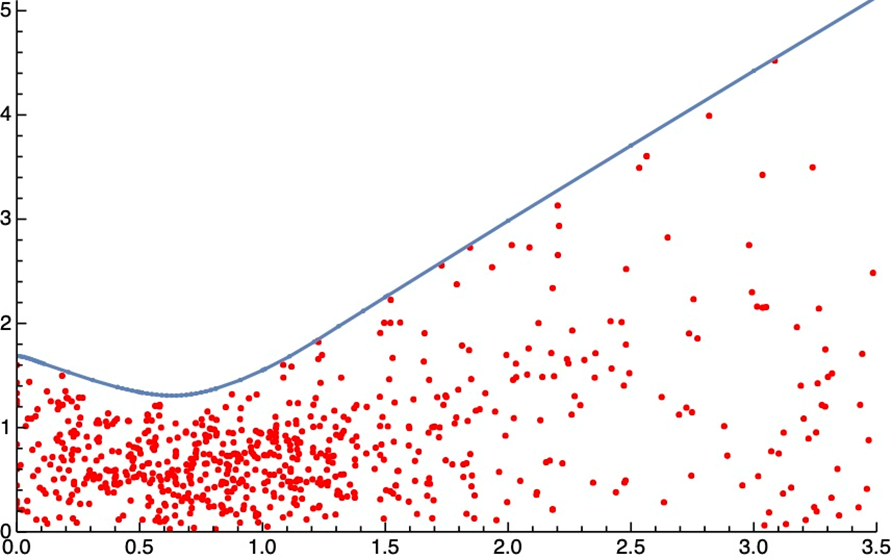
The ERC Consolidator project HARMONICON (Connecting Harmonic Analysis and Conformal Field Theory) aims to deepen and extend the connections between quantum field theory (QFT) and the problem of “sphere packing,” which consists of determining the densest possible way to stack identical spheres in space. The goal is to develop a rigorous mathematical framework for conformal field theories, which constitute an important class of QFTs that remain unchanged despite a change in length scale, with numerous applications in particle physics and statistical physics. Physical observables in conformal field theories are characterized by power laws, governed by scale exponents. The HARMONICON project aims to determine these exponents in systems where this was not previously possible, particularly for three-dimensional polymer models.
Dalimil Mazáč a CEA researcher at the Institut de physique théorique (IPhT, CEA / CNRS).