
Entangling and detecting two spins in a transistor
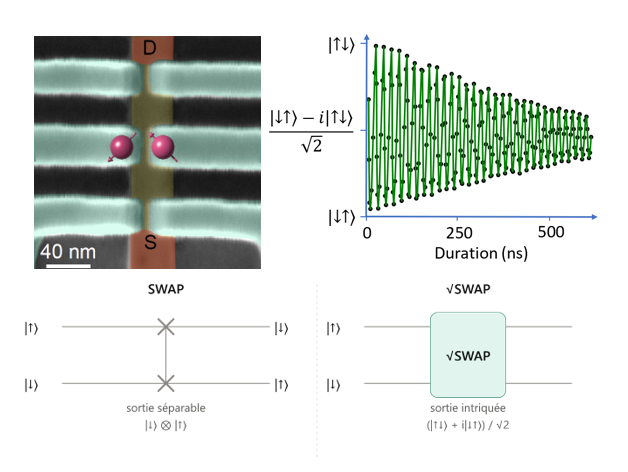
By combining radio-frequency and quantum technologies on silicon, researchers have demonstrated that it is possible to determine the state of a spin qubit simply by analysing how a radio-frequency wave is reflected by the circuit.
References:
Pierre Hamonic, Mathieu Toubeix, Guillermo Haas, Jayshankar Nath, Matthieu C. Dartiailh, Biel Martinez, Benoit Bertrand, Heimanu Niebojewski, Maud Vinet, Christopher Bäuerle, Franck Balestro, Tristan Meunier, Matias Urdampilleta,. Single-shot in situ readout of a spin qubit unit cell. Nature Electronics 9, 868–875 - Published: 17 June 2026.
DOI: https://doi.org/10.1038/s41928-026-01654-9 (open access article)
Quantum computing relies on the laws of quantum mechanics to process certain operations in a radically different way to classical computers. However, its development requires the ability to control a large number of basic units – qubits – whilst preserving their quantum state with a very high degree of efficiency. Among the various possible implementations for these qubits, spin qubits in silicon represent a particularly promising avenue for meeting this challenge: they can be confined within transistor-like structures and controlled electrically, whilst benefiting from the excellent technological maturity of the silicon industry and CMOS processes. Harnessing this industrial potential is essential for developing quantum architectures incorporating a large number of qubits and bringing quantum processors closer to the integration capabilities already achieved by microelectronics.
This research was carried out in the following CNRS laboratory:
Institut Néel (NEEL, CNRS)
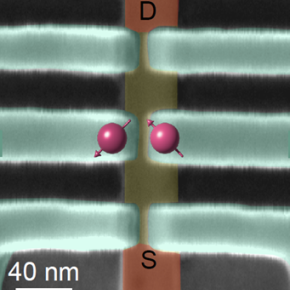
One of the major challenges in scaling up lies in the simultaneous control and readout of a large number of qubits, which currently requires a significant number of connections and electronic components. A collaboration between researchers and the start-up Quobly has recently led to the creation of a ‘building block’ for quantum computing using the same technologies as conventional electronic chips. In this device, quantum information is carried by the spin of electrons, an intrinsic property of these particles. The main innovation of this work lies in the method used to read this information whilst manipulating it coherently. Instead of using complex detectors that take up considerable space on quantum chips, the researchers have employed a very simple electrical circuit through which a radio-frequency wave travels and is reflected off the qubit. Extremely small variations in the qubit’s electronic state alter the amplitude and phase of the radio wave, thereby enabling the qubit’s state to be detected after the signal has been demodulated. This method enables rapid and reliable readout of qubits. Furthermore, this work has shown that the quantum information stored in these qubits is not affected by interaction with the radio-frequency signal – a crucial point in the development of quantum systems with long coherence times.
These results show that this approach can be implemented on devices manufactured in a technological environment similar to that of the integrated circuit industry. They thus demonstrate that it is possible to combine the performance of silicon spin qubits with microelectronic fabrication techniques, whilst reducing the complexity of the wiring required to control and read the qubits. In the longer term, the integration of qubits fabricated using CMOS technologies with control and readout circuits directly integrated into the processor could significantly reduce the complexity of quantum architectures and facilitate their scaling up. This work has been published in the journal Nature Electronics.