
Dispersion of swimming microalgae under flow conditions
Recent research reveals how microscopic mobile algae take advantage of the external flow in their liquid environment when exploring their natural habitat.
References :
Enhanced dispersion of active microswimmers in confined flows, Marc Lagoin, Juliette Lacherez, Guirec de Tournemire, Ahmad Badr, Yacine Amarouchene, Antoine Allard, Thomas Salez, PNAS 122 (50) e2519691122 - Published on December 9, 2025.
DOI : 10.1073/pnas.2519691122
Open access : HAL
Microorganisms capable of swimming evolve primarily in flowing environments, so their activity under flow is just as instructive as in the absence of movement of the surrounding fluid, particularly for learning whether and how evolution has equipped these living beings with optimal strategies for moving and feeding in a constantly moving aquatic environment.
The present study was carried out in the following CNRS laboratory:
Laboratoire Ondes et Matière d’Aquitaine (LOMA, CNRS/Université de Bordeaux)
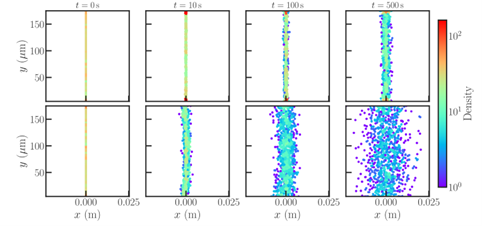
In a recent study, researchers used a unified approach combining microfluidic experiments, numerical simulations and statistical analysis to study how Chlamydomonas reinhardtii, a swimming microalga, disperses in confined flows. The results extend the classical Taylor-Aris dispersion theory, initially intended to account for the diffusion of passive Brownian particles under shear flow, to active swimmers, revealing a transition between ballistic and diffusive behaviours influenced by the strength of the flow. The researchers show that shear has a complex, non-linear effect on the dynamics of swimmers, which sophisticatedly enhances their exploration of their environment. The study's findings offer valuable insights into the behaviour of micro-swimmers in fluids, which is relevant to both artificial and natural environments. This work has important implications for microbial ecology, suggesting new ways to account for and rationalise processes such as biofilm formation, nutrient transport and pathogen dispersal in ecosystems where fluid dynamics shape movement and determine interactions between microorganisms. It is published in the Proceedings of the National Academy of Sciences (PNAS).