
Consistency amidst quantum chaos
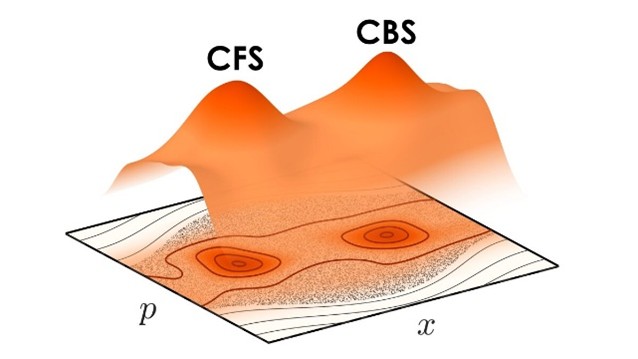
Using a Bose-Einstein condensate trapped in an optical lattice, researchers have made the first direct observation of the coherent forward scattering (CFS) peak, a quantum phenomenon predicted more than ten years ago but never directly measured, which reveals a profound link between this signal and two fundamental properties of chaotic quantum systems.
References:
Probing non-ergodicity and symmetry via direct measurement of coherent scattering in a shaken rotor. F. Arrouas, J. Hébraud, N. Ombredane, E. Flament, D. Ronco, N. Dupont, G. Lemarié, B. Georgeot, Ch. Miniatura, J. Billy, B. Peaudecerf, D. Guéry-Odelin, Nature Communication - Published: 17 June 2026.
DOI: 10.1038/s41467-026-74302-7 (article in open access)
A wave propagating through a disordered medium — such as light in thick fog — rapidly loses the ‘memory’ of its initial direction after multiple random scatterings. However, for a coherent wave (laser light, a sound wave, a wave of matter, etc.), quantum physics predicts that this ‘memory’ is never completely erased. This manifests itself in two interference effects: an increased probability of reversing direction (coherent backscattering, CBS) and, more surprisingly, an increased probability of continuing in the initial direction (coherent forward scattering, CFS). CBS has been known since the 1980s and has been observed in numerous systems. CFS, however, had never before been measured directly.
CFS is closely linked to another phenomenon known as ‘Anderson localisation’, which occurs when the disorder in the propagation medium is sufficiently intense. In this case, the wave ceases to propagate and remains confined to a region of space. It is precisely in this regime that the CFS emerges, indicating that the wave ‘remembers’ its point of origin. This is a sign that the system does not uniformly explore the space of accessible states, contrary to what classical statistical physics predicts (the system is then said to have become ‘non-ergodic’). The experimental difficulty associated with detecting this phenomenon stems from the fact that measuring it requires determining the direction of propagation of the localised wave, which is difficult to achieve with light or sound waves.
This research was carried out in the following CNRS units:
Laboratoire collision agrégats réactivité (LCAR, CNRS / Université de Toulouse)
Laboratoire de physique théorique (LPT, CNRS/Université de Toulouse)
Institut de physique de Nice (INPHYNI, CNRS / Université Côte d'Azur)
IRL MajuLab (CNRS / Sorbonne Université / Université Côte d'Azur, Université Nationale de Singapour / Université de technologie de Nanyang)
In a recent paper, a collaboration involving researchers from LCAR and LPT (both CNRS/University of Toulouse), together with partners from Singapore, Nice and Brussels, succeeded in observing the phenomenon in quantum waves. The researchers trapped a Bose–Einstein condensate (a cloud of rubidium atoms cooled to near absolute zero) in a one-dimensional optical lattice (a periodic light trap for the atoms), the depth and position of which they periodically modulated. This modulation induces chaotic dynamics, analogous to that of a particle bouncing within an irregular cavity. Using optimal control algorithms, they prepared the matter wave in an initial state that was highly localised in position, then allowed it to evolve under this controlled chaos. A comprehensive measurement of the final quantum state enabled them to directly visualise the emergence of the CBS and CFS peaks in the position distribution. Furthermore, by varying the modulation parameters, the researchers were able to control the symmetries of the dynamics, such as time-reversal symmetry and parity (left-right) symmetry, and measure their precise impact on the two peaks. In doing so, they demonstrated that the presence of these symmetries characteristically alters the contrast and growth dynamics of the CFS. These results highlight that the CFS is not only a robust marker of non-ergodicity, but also a diagnostic tool for the symmetries of a chaotic (or disordered) quantum system.
This demonstration opens up new avenues for the study of other forms of non-ergodicity, particularly in quantum systems with a large number of interacting particles, where the underlying mechanisms are the subject of extensive research. This work has been published in Nature Communications.