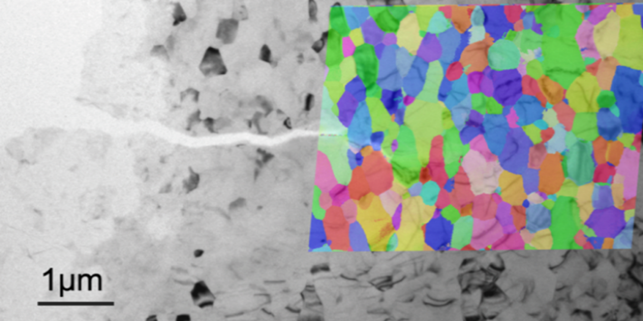


A complex mechanism of plasticity observed in metals
In fine-grained metals, the usual plastic deformation is replaced by new mechanisms involving the interfaces between crystalline domains, known as grain boundaries. In a recent study, researchers observed for the first time, on the scale of a large set of grains in aluminum, the coupling between the movement of grain boundaries and the macroscopic deformation of the metal.
References :
Quantifying grain boundary deformation mechanisms in small-grained metals, Romain Gautier, Frédéric Mompiou, Oliver Renk, Christophe Coupeau, Nicolas Combe, Gregory Seine, Marc Legros, Nature 648, 327–332 - Published: 10 December 2025.
DOI: 10.1038/s41586-025-09800-7
Article available online: https://rdcu.be/eT5sd
As crystalline materials, metals are composed of crystalline domains separated by interfaces, known as grain boundaries. In most cases, plastic deformation of metals involves the nucleation and propagation within the grains of nanometric linear defects, known as dislocations, in order to prevent fracture. Over the past twenty years, with the advent of materials with very small grains (on the order of microns and below), new plasticity mechanisms have been discovered. Due to the difficulty of creating dislocations, plasticity develops in these materials preferentially at grain boundaries, in particular through a mechanism coupling deformation and boundary migration. Although this mechanism has been described both experimentally and theoretically at the interface scale, its importance at the collective scale of a large number of grains was still poorly documented.
The present study was carried out in the following CNRS laboratories:
Centre d'élaboration de matériaux et d'études structurales (CEMES, CNRS)
Physique et Ingénierie en Matériaux, Mécanique et Énergétique (Institut P', CNRS)
To achieve a relevant description of this scale, an international team of researchers combined mechanical tests at temperature, deformation measurements, and maps showing the displacement of grain boundaries in ultrafine-grained aluminum. These measurements are based in particular on observations using both atomic force microscopy and electron microscopy. They show that the deformation caused by the movement of joints occurs predominantly, regardless of the nature of the interface, but is much less effective than theoretical models predicted. These models did not take sufficient account of particular defects, called disconnections, which move along the joints. However, experimental observations suggest that these disconnections are more numerous than expected and probably operate in conjunction with high-temperature diffusion, contrary to what was previously assumed.
This work could explain certain post-heat treatment deformations observed on parts used in industry and thus help to overcome these defects in the production of metals and alloys. Above all, it calls for a paradigm shift regarding grain boundaries in metals, which should no longer be considered as elementary defects, but as crystal lattices in their own right, carrying their own defects that can influence the behavior of the boundary at their level. These results are published in the journal Nature.